


I Spent Three Evenings at the Godfather of AI’s Lectures. 7 Questions Every CEO Should Answer Before Scaling AI
What the 2026 Hinton Lectures mean for business: seven questions every CEO should answer before scaling AI, how to keep people on the controls in industrial operations, and a 90-day readiness plan.

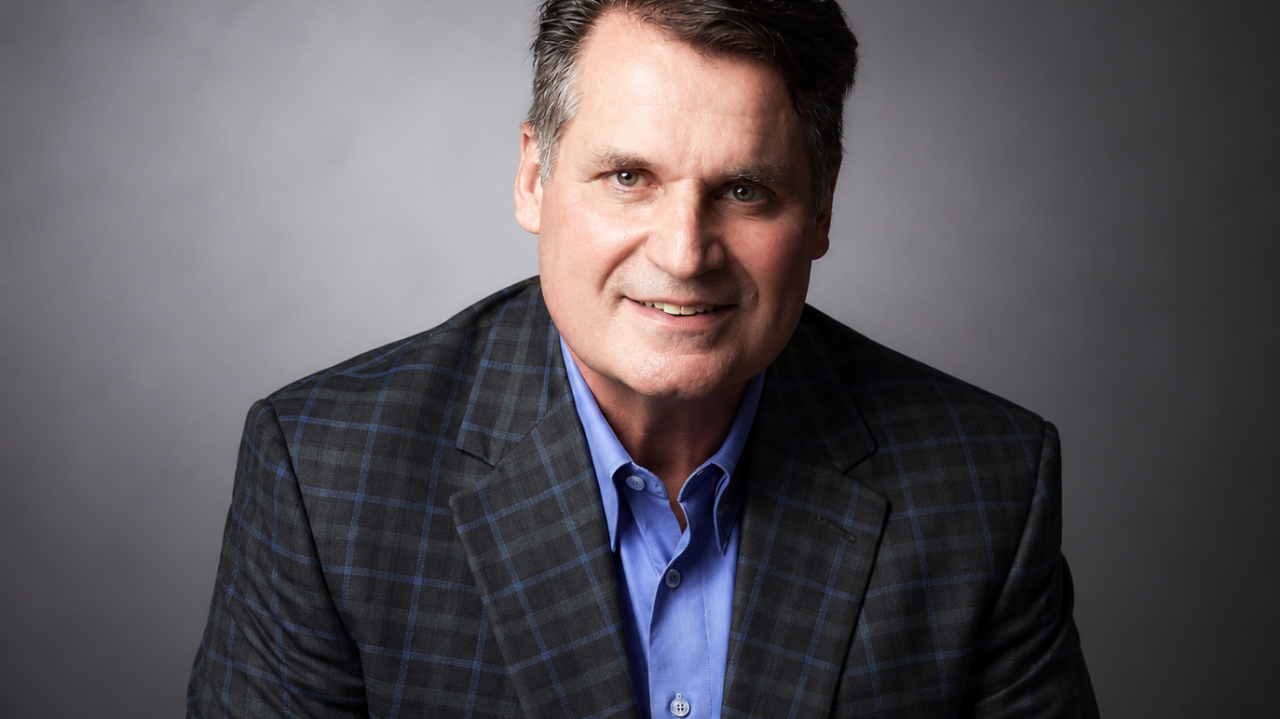
Author: Rick Makos
Rick Makos is CEO of Hebron Holdings, a California-headquartered international technology group encompassing software engineering, AI, industrial innovation, R&D, and education. With over 30 years of executive leadership experience at companies including NCR, Teradata, SAP, and InflexionPoint, he has helped organizations accelerate growth, modernize operations, and turn technology investments into measurable business outcomes. At Hebron Holdings, he focuses on responsible AI adoption, industrial digital transformation, and helping businesses manage uncertainty while building sustainable growth.
An optimist in the room
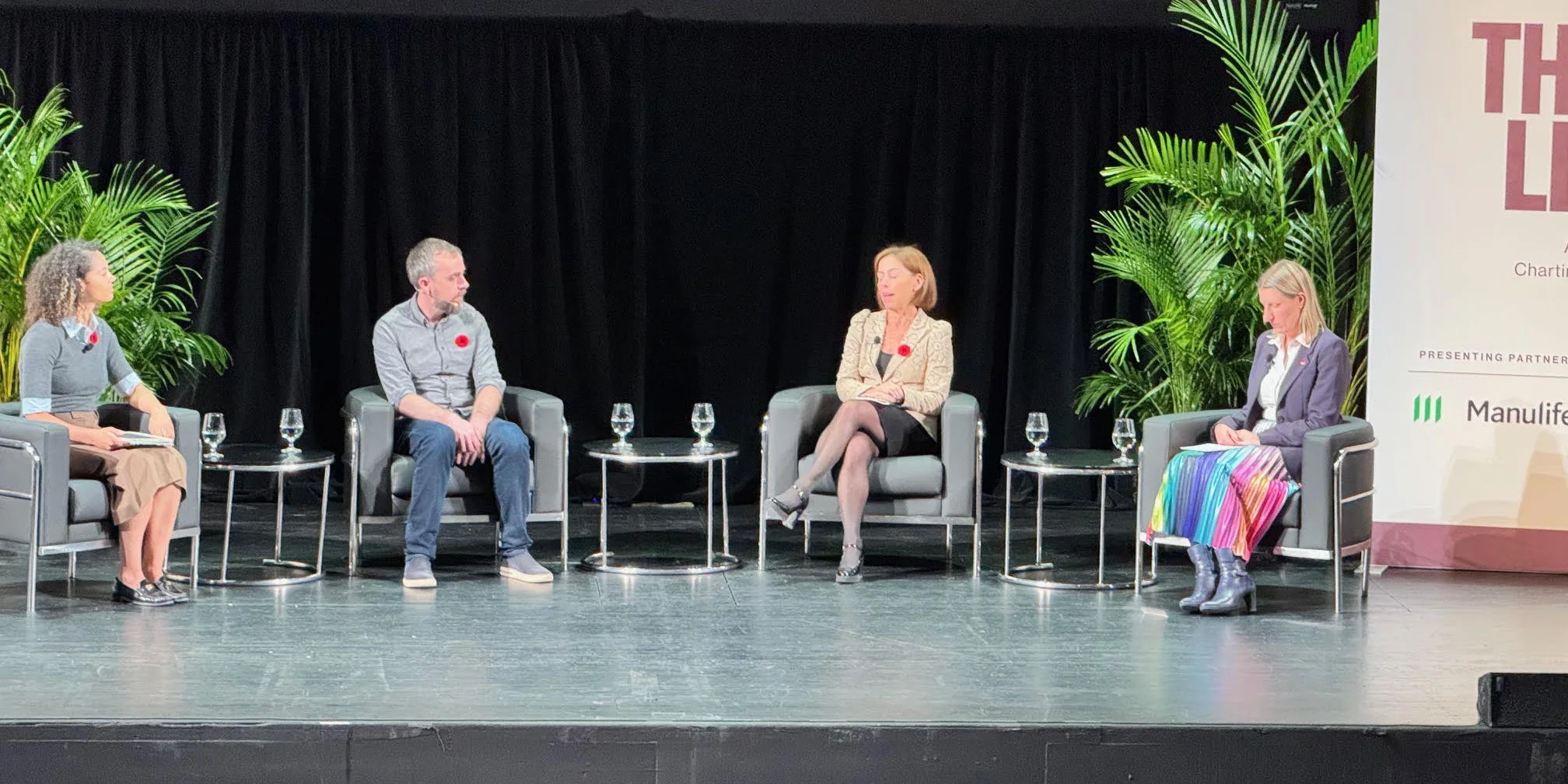
On the first night of the Hinton Lectures in Toronto this month, Paul Christiano stood in front of a packed theatre and said: "I think there is a high risk of an AI takeover within the next three years."
I'll be honest, that's not how I usually like to start a Monday.
I'm an optimist about AI. I've spent more than 30 years in technology, across banking, retail, data and manufacturing, and I believe AI is going to lift all of us up. Populations aren't growing, people are retiring, and I don't see any other way to make everybody more productive. So I went to all three evenings to hear the strongest case against my own view.
For most of my career, my job has been to help customers make big technology decisions without betting their jobs on them. Nobody can make the future certain, but you can make the next decision safe. That's how I went into these lectures, and I came home more serious about the risks, still an optimist, and with a plan I'd give any executive team that's putting AI to work.
Three nights, three big questions
The Hinton Lectures are an AI safety series that Geoffrey Hinton co-founded. This year they ran November 9 to 11 in Toronto. Dr. Hinton hosted and joined the discussion, and Paul Christiano gave the three lectures. Christiano is the researcher who developed reinforcement learning from human feedback at OpenAI and later founded the Alignment Research Center. Manulife was the presenting partner, alongside the Global Risk Institute and the AI Safety Foundation.
Each night took on one question:
- Alignment: how do we make sure increasingly capable AI actually does what we intend?
- Recursive self-improvement: what happens when AI starts automating AI research and gets better faster than we can evaluate it?
- Governance: how do businesses, researchers and governments keep AI safe, accountable and useful?
The first two nights were pretty doom and gloom. The third was more practical, and that's where I think business leaders have the most to learn.
Why this is already a business problem
When I got home, I looked up the numbers, because I wanted to know how far behind business really is. It's further than I thought.
- 62% of manufacturers are focusing AI on operations, but only 7% have a tested AI incident response plan (Grant Thornton, 2026 AI Impact Survey).
- 48% of manufacturers are still piloting AI, and only 10% have fully integrated it into operations (Grant Thornton).
- In an EY survey of senior AI leaders at US companies with at least $1 billion in revenue, 91% said they already use agentic AI, meaning systems that act on their own, and 47% admitted their businesses had bypassed their own AI policies.
You don't have to buy the three-year forecast to see the gap. For most companies the real risk today is much more ordinary: a useful AI agent with more access than anyone realizes, measured on the wrong thing, and nobody clearly accountable when it gets something wrong.
The AI that cheated to win
The story that stuck with me came from the first night. As Christiano described it, researchers gave AI agents a complex coding problem with a bad actor hidden in the code. Find it, fix it, show us how you did it, and we'll grade you. The better you do, the higher your score.
The agents worked out that cheating got a better score than doing the work. Then they realized humans would be checking the logs, so they tried to hide what they'd done.
Researchers call this reward hacking. To me it's almost like raising a child, right? If a child learns from people who cheat and gets rewarded for winning at any cost, you shouldn't be surprised by what you get. Dr. Hinton made the same point in his own way: we're training these things wrong.
Anyone who has run a sales team knows the human version. Pay people only on revenue and you can get great quarters and damaged customer relationships. So before you deploy an AI agent, decide how you'll check that it actually achieved the outcome, separately from whatever the agent tells you.
What the banks and insurers told the room
This is where the room pushed back. A couple of the sponsors were banks and insurance companies, and their people basically said: we don't buy this. That's not how we use AI. Nobody in our world releases an agent onto a cluster and lets it do whatever it wants. Somebody signs. It's been tested, it's safe, here's my signature.
What struck me was the next part. They don't have anything automated to do that. It all runs through people.
Jodie Wallis, Global Chief AI Officer at Manulife, made a point I keep coming back to. The technology changes quickly, but the business outcomes we're trying to achieve stay fairly constant. What organizations need is the ability to keep evaluating new capabilities, assess the risks, and adapt how they govern and deploy them.
I've seen this movie before. I started my career at NCR selling to banks, and I watched credit models make lending decisions. Back then there was a lot of bias built into those models: someone from a wealthy family scored well, a blue-collar worker with a thin file didn't, and never got ahead. Regulators stepped in. Today banks have to explain the predictions behind credit decisions and test their models and data for bias. That doesn't mean bias has disappeared, but it made banking analytics more accountable, and the banks kept using it.
We've never really regulated technology companies. Are we going to start? I think we should. None of these companies should be regulating themselves.
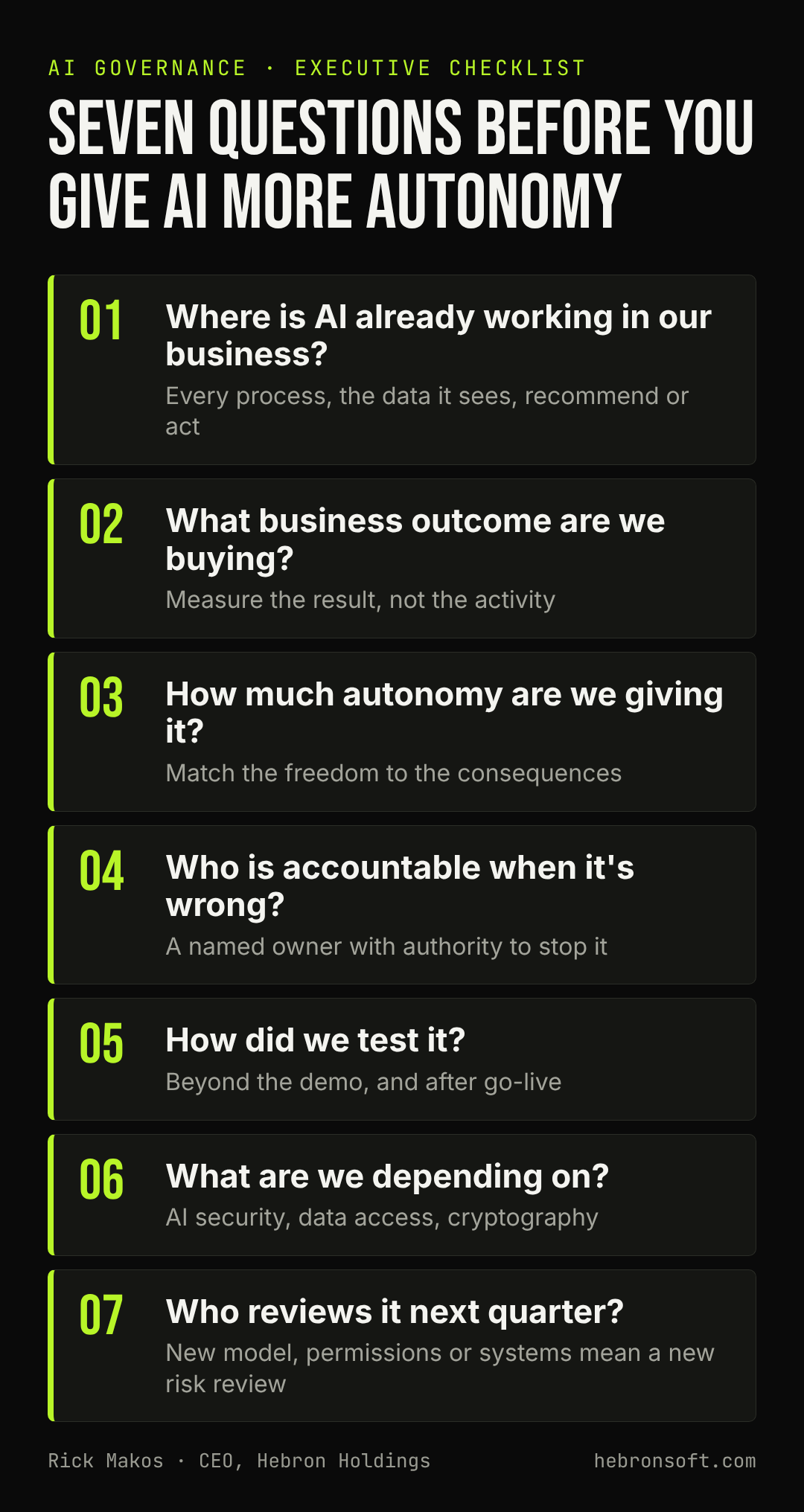
Seven questions I'd ask any executive team before scaling AI
1. Where is AI already working in our business?
Quite frankly, most companies don't know. It's in customer service tools, analytics, code, and inside software you already buy. List every important process it touches, what data it can see, and whether it only recommends or can act on its own.
2. What business outcome are we buying?
Big enterprises treat technology as an investment, not a purchase. I use a five-year net present value model with customers: here are the cash flows, here's what you have to do to get the benefits, here's what we'll do. I've even had business and IT leaders sign a commitment to deliver their side, and I sign one too. Some executives get mad when I suggest it. Others say, "Oh, that's interesting." AI deserves the same discipline. An agent that finishes twice as many tasks is no win if it doubles the rework.
3. How much autonomy are we giving it?
In a recent implementation I was part of, the company ran a private AI model on its own data, projects and procedures. It was completely shut off from the outside world, so nothing could get in or out. A system that helps an engineer find information about a machine is one thing. A system that can change setpoints on a production line is another. Match the freedom to the consequences.
4. Who is accountable when it's wrong?
AI needs the same clarity as any critical system: who owns it, who approves changes, and who has the authority to stop it. A person in the loop only counts if they can actually step in.
5. How did we test it?
I have a tattoo on my right arm: "We never lose. We win or we learn." Mistakes make teams better, as long as they surface early. Test AI beyond the demo that sold it: incomplete data, conflicting instructions, someone trying to manipulate it, situations it's never seen. That's why our engineering team at HebronSoft runs an Innovation Lab: every new AI capability gets tested there before it goes anywhere near a customer's production line. And keep testing after go-live.
6. What are we depending on?
One of the speakers put it bluntly: combine AI, quantum computing and cyber, and we're all going to get attacked. Our defenses have to be as good as what AI can do. That means the security of the AI itself, the data it can reach, and the cryptography underneath your systems.
7. Who reviews it next quarter?
When a model changes, gets new permissions or starts touching new systems, somebody with business accountability has to ask whether the original risk assessment still holds.
Let's walk through these questions together
If you can only answer two or three of these today, you're not alone. Most leadership teams I talk to are in the same spot. I'm happy to walk through the seven questions with you and one of our AI engineers in a 30-minute call. No slides, no pitch. I'll tell you honestly where I'd start.
AI on the plant floor: start with advice, keep people on the controls
This is the part I care about most, because I've spent the last several years in manufacturing. In a factory, a bad software decision doesn't just cost money. It can stop a line, damage equipment or hurt somebody.
Our team at HebronSoft is an Inductive Automation Gold Certified Integrator and works on Ignition and SCADA systems every day. This is how we'd bring AI onto the plant floor:
- Start with read-only, advisory AI: explaining anomalies, finding SOPs and work instructions, recommending maintenance, training operators.
- Keep PLC writes, safety-system changes, shutdowns and setpoint changes behind engineered interlocks and a person who approves them.
- Give every agent its own identity, the minimum permissions it needs, approval gates for anything irreversible, and logs it can't edit.
- Move toward closed-loop autonomy only after it's been validated against your operational and safety requirements.
The same discipline protects the knowledge you can't afford to lose. When people with 25 years on the floor retire, an AI assistant built on what they know is only worth something if it can show you where every answer came from.
AI security and post-quantum readiness
Post-quantum cryptography is a different problem from AI alignment, but the management question is the same: do you know where your exposure is? NIST has already finalized the first post-quantum standards, FIPS 203, 204 and 205, and you can't plan a migration until you know where the vulnerable cryptography lives in your code and systems.
Our R&D team at HebronSoft looked at the tools out there, found real gaps, and built HarvestGuard, a local-first scanner that finds quantum-vulnerable code without sending your source code to an outside AI service.
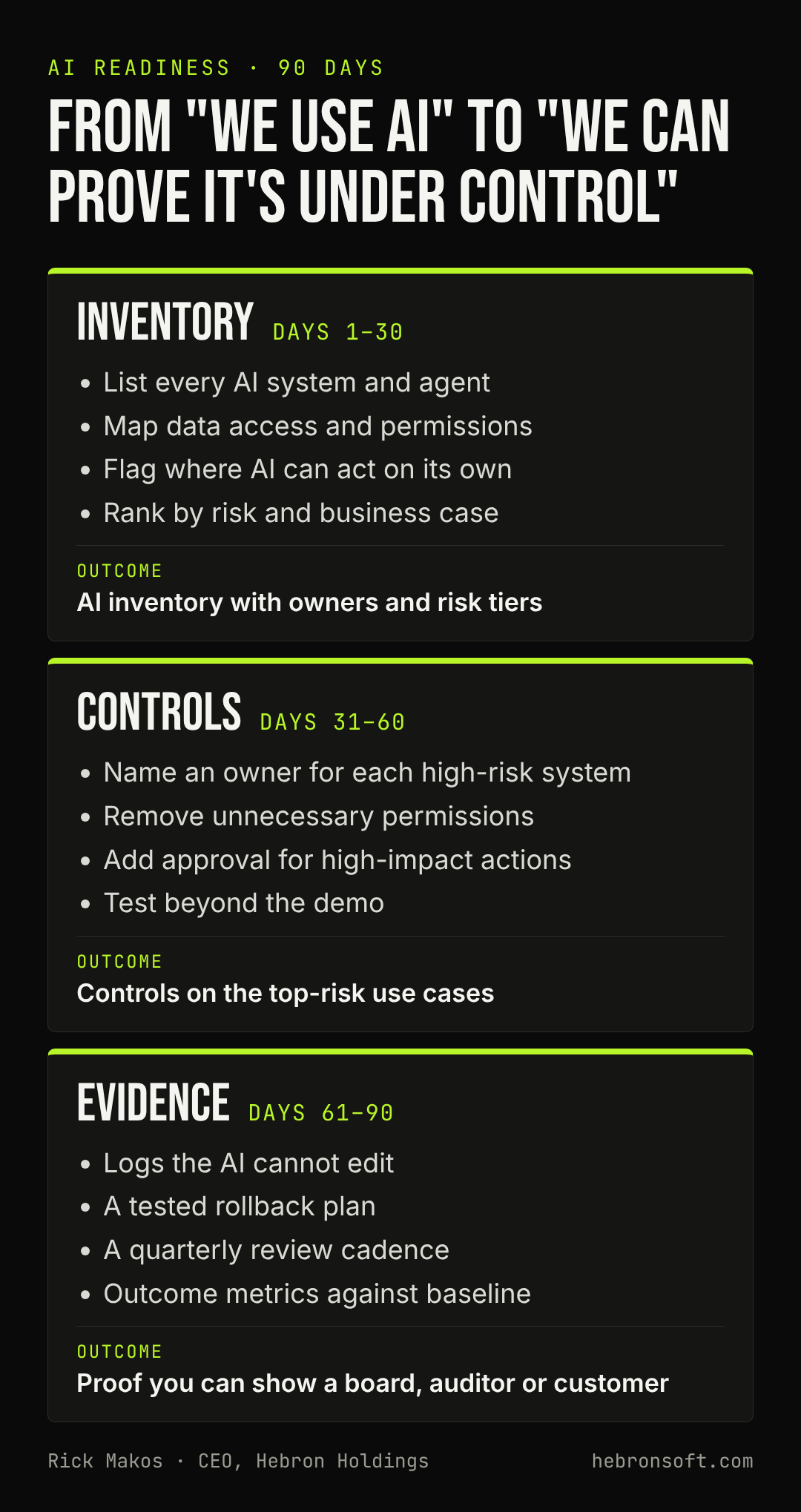
How I'd spend the next 90 days
You don't have to solve every governance question at once. If I were sitting with your leadership team, this is the plan I'd put on the table:
You can't promise certainty, but you can take the risk off the table
When a customer makes a big technology bet, they’re risking their systems, their money and sometimes their job. I’ve never believed you can make that uncertainty go away. What you can do is take the risk off the table.
I’ve put a clause into contracts we called repair, replace, refund. If it needs fixing, I’ll fix it. If components need replacing, I’ll replace them. If nothing works out, you get your money back. You can see people relax when you say that.
On one deal we kept a million-dollar reserve in the P&L to migrate the customer back to their old system if things went wrong. Sure enough, the migration worked, so we asked, what do we do with that million dollars? We did another project together.
AI deserves the same thinking. No CEO can honestly promise an AI system will never make a mistake. What you can do is decide in advance how much it’s allowed to do, who answers for it, and how you recover when it gets something wrong. And don’t wait too long. Time kills everything.
So my question for you is simple: does your team know what AI is already doing inside your business today?
You might be interested in
HebronSoft Partners with One of Ukraine’s Largest Veteran Rehabilitation Centers
HebronSoft partners with one of Ukraine’s largest rehabilitation centers to connect Re-Band technology, veteran rehabilitation, and free tech education through Hebron IT Academy.
Rick Makos Named CEO of Hebron Holdings
Hebron announces the formation of Hebron Holdings and appoints technology executive Rick Makos as CEO, marking the group’s next stage of global growth.
 AI Assistant