


Post-Quantum Cryptography Audit: Finding Quantum-Vulnerable Code Before the 2030 Deadline
A behind-the-scenes look at how HebronSoft's R&D team evaluated post-quantum cryptography tools, identified critical gaps, and built HarvestGuard - a local-first scanner that helps engineering teams prepare for post-quantum migration.

The Clock Is Already Running
How governments and regulators are preparing for the quantum threat — and why your codebase needs to catch up now.
In 2024, the U.S. National Institute of Standards and Technology (NIST) finalized the first post-quantum cryptography standards - FIPS 203, FIPS 204, and FIPS 205. Together, they define the first generation of standardized quantum-resistant algorithms, marking the shift of post-quantum cryptography from research into compliance.
Governments quickly followed.
In the United States, Executive Order 14306 (2025) expanded federal post-quantum cybersecurity efforts. One year later, Executive Orders 14412 and 14413 accelerated the national strategy for quantum security and quantum innovation.
For U.S. federal agencies and contractors, the roadmap is now explicit:
✓ Dec. 31, 2027 — Department of Commerce completes its PQC migration pilot.
✓ Dec. 31, 2030 — High-value federal assets transition to post-quantum key establishment; federal contractors comply with NIST FIPS standards.
✓ Dec. 31, 2031 — Post-quantum authentication becomes mandatory for high-impact systems.
The Executive Orders also require federal contracting agencies to introduce regulations aligning contractors with NIST standards and expanding vulnerability disclosure programs to include cryptographic weaknesses.
The European Union is following a similar path. ENISA published its post-quantum cryptography recommendations in 2023, while NIS2 and DORA are making cryptographic resilience part of broader cybersecurity and ICT risk management.
Regulation is only part of the story. Recent research suggests that the quantum resources required to break today's public-key cryptography may be significantly lower than previously estimated. Google has already announced plans to migrate its products to quantum-resistant cryptography by 2029, while China continues investing heavily in quantum technologies through its latest Five-Year Plan.
The threat begins not when a quantum computer exists, but when encrypted data is captured today and stored until one does
This is the Harvest Now, Decrypt Later problem.
And it leads to one practical question.
Where is your quantum-vulnerable cryptography? Most organizations don't know.
The tools existed. We just couldn't trust them
Why We Built HarvestGuard
When HebronSoft's R&D team began evaluating post-quantum cryptography, the first step was obvious: assess the tools already available.
The results exposed three fundamental limitations.
Commercial tools were closed-source. As Bohdan Shylo from HebronSoft's engineering team explains explains:
"We don't know how it works, how it scans, whether it uses AI, where the data goes."
For a security audit, that lack of transparency is a risk in itself. A cryptographic scanner should not be another black box.
Open-source alternatives had the opposite problem. They relied primarily on pattern matching, which detects known signatures but often misses cryptographic context and implicit vulnerabilities.
AI-assisted tools introduced a different concern: source code was typically sent to external cloud models. For proprietary software and sensitive client environments, that was not an acceptable trade-off.
Instead of compromising on transparency, accuracy, or privacy, the team built its own solution.
From the beginning, the requirements were clear:
- support the languages HebronSoft uses in production;
- keep all AI analysis local, with no source code leaving the machine;
- map every finding directly to the appropriate NIST-standardized replacement.
That work became HarvestGuard - first developed for HebronSoft's own engineering teams and now integrated into every post-quantum cryptography engagement.
Two ways to use it
HarvestGuard runs as a CLI tool — scan a repository from the terminal and receive a structured report. It also runs as an MCP server, which means it integrates directly with Claude Code: a developer can ask it to audit the current project and receive findings inline, without leaving the development environment.
How HarvestGuard Works
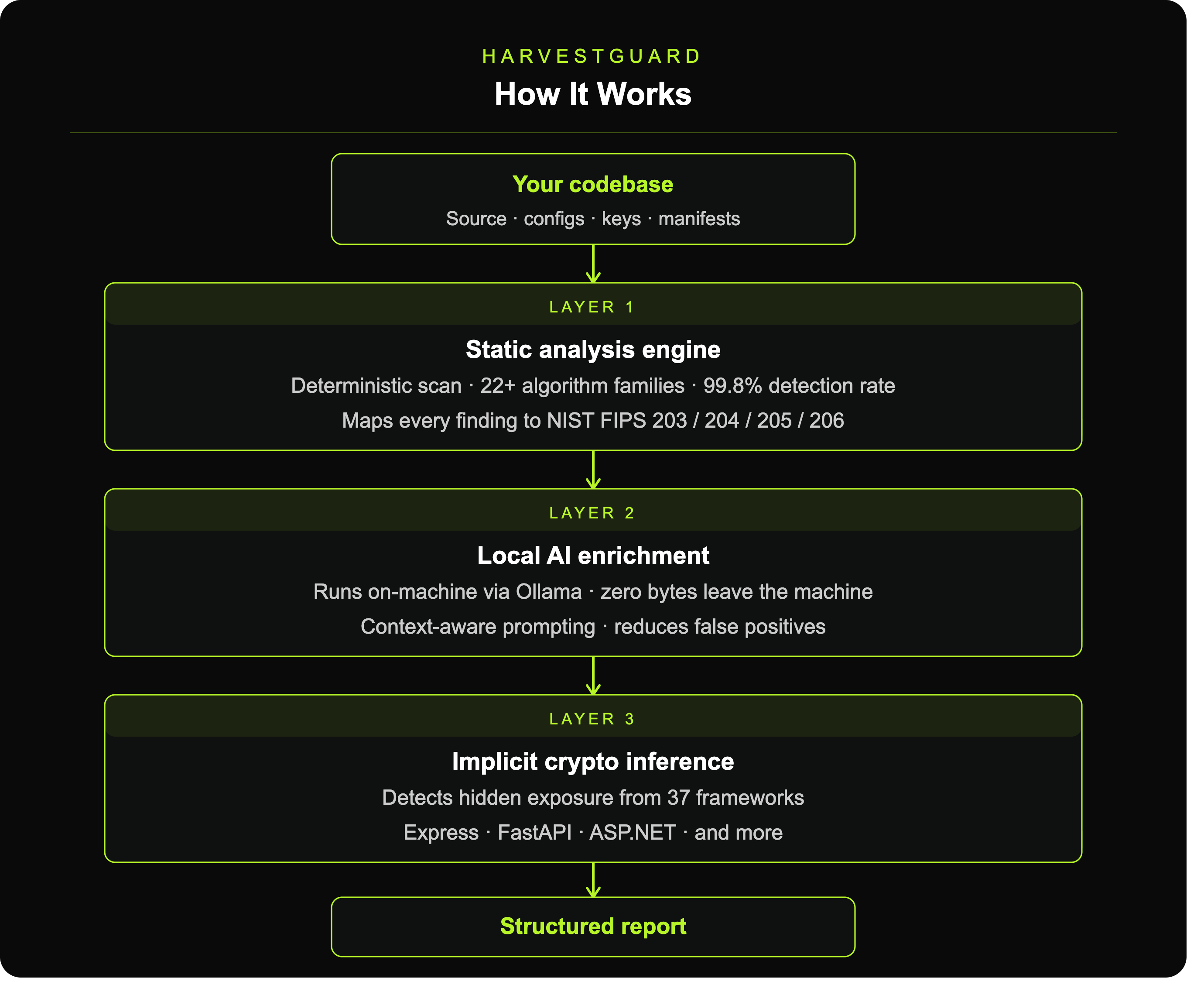
HarvestGuard combines deterministic static analysis with local AI reasoning to identify quantum-vulnerable cryptography that conventional scanners may miss. The process consists of three complementary layers.
Layer 1 — Static Analysis Engine
The first layer performs a deterministic scan of source code, configuration files, certificates, dependency manifests, and infrastructure artifacts. It identifies explicit cryptographic algorithms, APIs, libraries, protocols, and key material, then maps every finding to the appropriate NIST FIPS 203, 204, 205, or 206 standard.
Layer 2 — Local AI Enrichment
Not every cryptographic implementation can be understood through static rules alone. HarvestGuard enriches findings using a locally running language model via Ollama, providing contextual analysis while ensuring that no source code or sensitive data leaves the machine.
Layer 3 — Implicit Crypto Inference
Modern frameworks frequently perform cryptographic operations automatically. TLS negotiation, JWT signing, and certificate handling often occur without explicit calls in application code.
HarvestGuard infers these hidden cryptographic dependencies across 37 frameworks in the Python, Node.js, and .NET ecosystems, helping identify exposure that traditional pattern-based scanners may overlook.
Example Finding
Each finding includes the information engineers need to assess risk and plan migration:
- Location — file, line number, and surrounding context.
- Algorithm detected — for example RSA-2048, ECDSA P-256, or AES-128-CBC.
- Quantum risk — the attack model that makes the algorithm vulnerable.
- Severity — Critical, High, or Info.
- Recommended replacement — the corresponding NIST-standardized algorithm.
The output is generated as a structured report that can be integrated into engineering workflows or reviewed directly by development teams.
Coverage
| Layer | Coverage |
| Source code | Python, Node.js, TypeScript, C# |
| Configuration files | 8 formats including .env, YAML, TOML, XML |
| Keys and certificates | 6 formats including RSA, EC, SSH, PGP, X.509 |
| Dependency manifests | 37 frameworks with implicit crypto inference |
| Algorithm families | 22+ mapped to named FIPS replacements |
What we could not find in existing tools
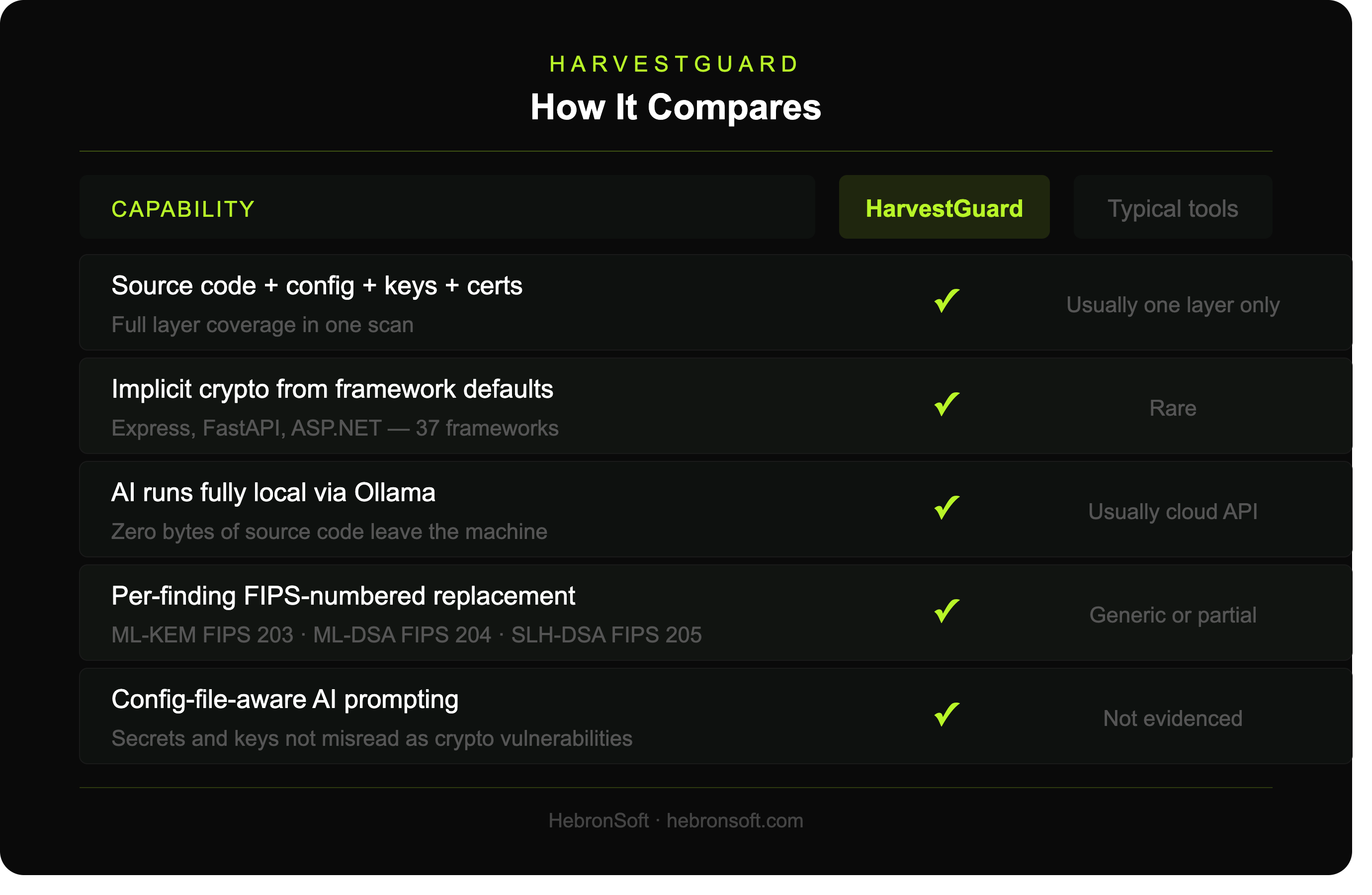
How HarvestGuard Compares
During our evaluation of the post-quantum cryptography ecosystem, we found that most solutions addressed only part of the problem. Some focused on infrastructure, others on source code, and some relied on cloud-based AI analysis.
HarvestGuard combines the capabilities our engineering team considered essential for a practical post-quantum cryptography audit.
Unlike many existing solutions, HarvestGuard combines deterministic analysis, local AI reasoning, and migration guidance in a single workflow. The goal is to give engineers enough context to begin migration, not just a list of what is broken.
Engineering Value for Clients
HarvestGuard is not a commercial product. It is part of HebronSoft's engineering process.
Every software project is scanned for quantum-vulnerable cryptography before delivery. Each finding is documented, assessed, and mapped to the appropriate NIST-standardized replacement, giving engineering teams a clear inventory of cryptographic risk before software reaches production.
The result is an engineering artifact — documentation that supports remediation, architecture decisions, and future compliance.
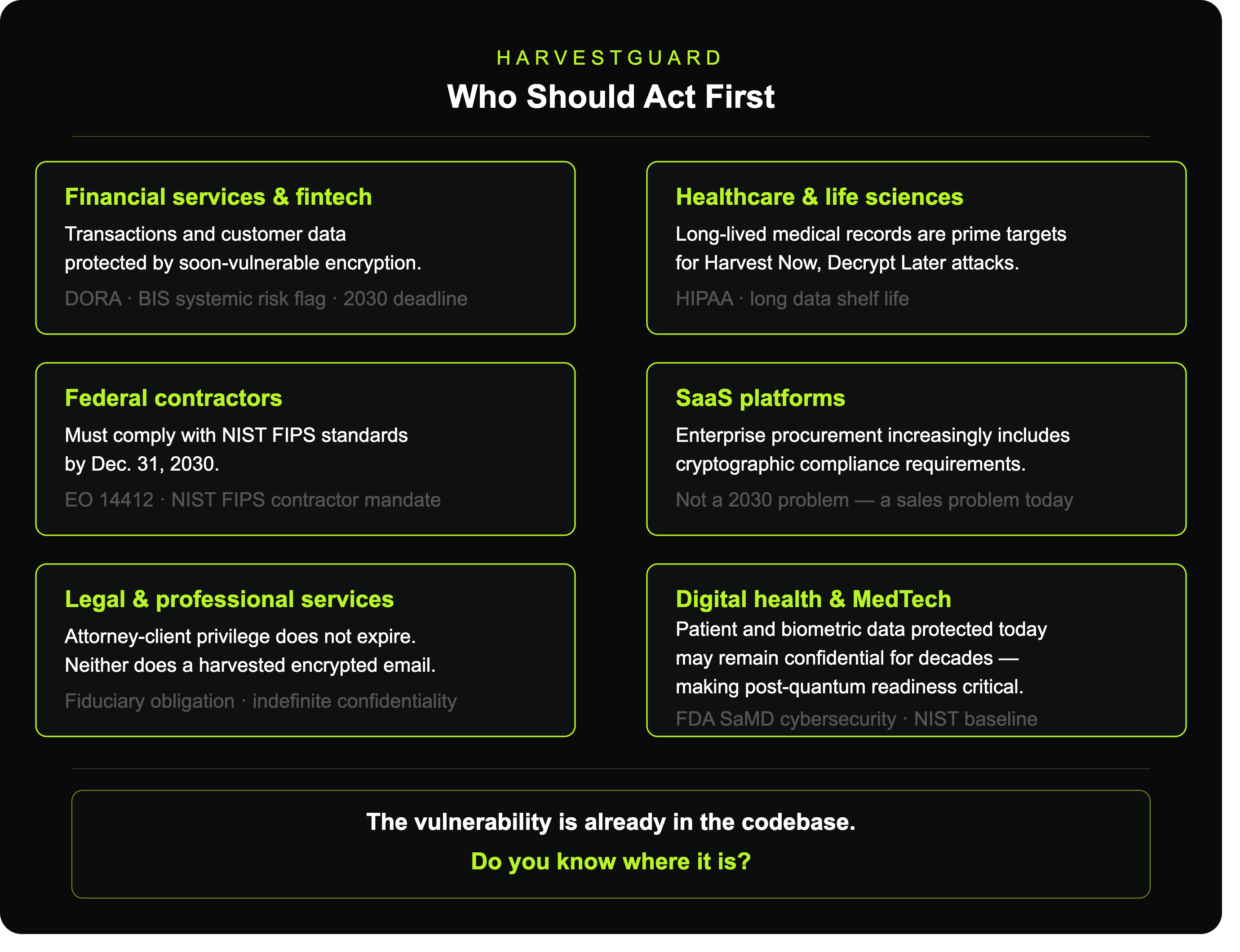
For organizations in regulated industries
Organizations operating in healthcare, finance, critical infrastructure, or the U.S. federal supply chain are increasingly expected to demonstrate cryptographic resilience.
By incorporating post-quantum cryptography audits into the development process, organizations gain documented visibility into the cryptography used across their applications long before regulatory deadlines require evidence.
For long-lived software platforms
Some data must remain confidential for years or decades. Applications that process medical records, financial information, intellectual property, or government data may still be protecting that information long after today's cryptographic standards become obsolete.
HarvestGuard helps identify where long-term cryptographic risk already exists, allowing migration planning to begin before future compliance becomes urgent.
For legacy systems
The highest-risk cryptography is often in software nobody has touched in three years — because it worked, and nobody looked.
Inherited applications frequently contain outdated algorithms, framework defaults, or cryptographic libraries that predate modern post-quantum standards.
HarvestGuard applies the same analysis to existing systems as it does to new development projects, providing a practical starting point for modernization.
The Result
When HebronSoft delivers software, clients receive a codebase that has been audited against post-quantum cryptography standards. They know what was found, what requires migration, and the NIST basis for every recommendation.
That documentation supports engineering teams, internal compliance programs, enterprise procurement, and—when regulatory deadlines arrive—demonstrates that the work has already been done.
Security does not wait for the hardware to arrive. Neither do we.
Start With Visibility
The first step in any migration is knowing what you have.
Most organizations that begin preparing for post-quantum cryptography discover the same thing: the vulnerable cryptography is rarely where they expect it. It lives inside framework defaults, forgotten configuration files, legacy dependencies, and certificates that will outlive today's standards.
The standards are finalized and the deadlines are approaching.
What most engineering teams still do not have is an inventory.
HarvestGuard exists because we needed that inventory ourselves. Existing tools did not give us enough confidence in what they found, how they found it, or how they handled our source code. So we built one we could trust—and today we use it on every project we deliver.
If you build software that protects data expected to remain confidential for years — whether in healthcare, finance, government, manufacturing, or other enterprise environments — understanding where your quantum-vulnerable cryptography lives is no longer a future problem. It is an engineering task that can be addressed today.
HebronSoft builds software designed to last. That means designing for the cryptographic standards that will define the next decade — not the last one.
If you want to understand what post-quantum readiness looks like for your project, let's start the conversation.
You might be interested in
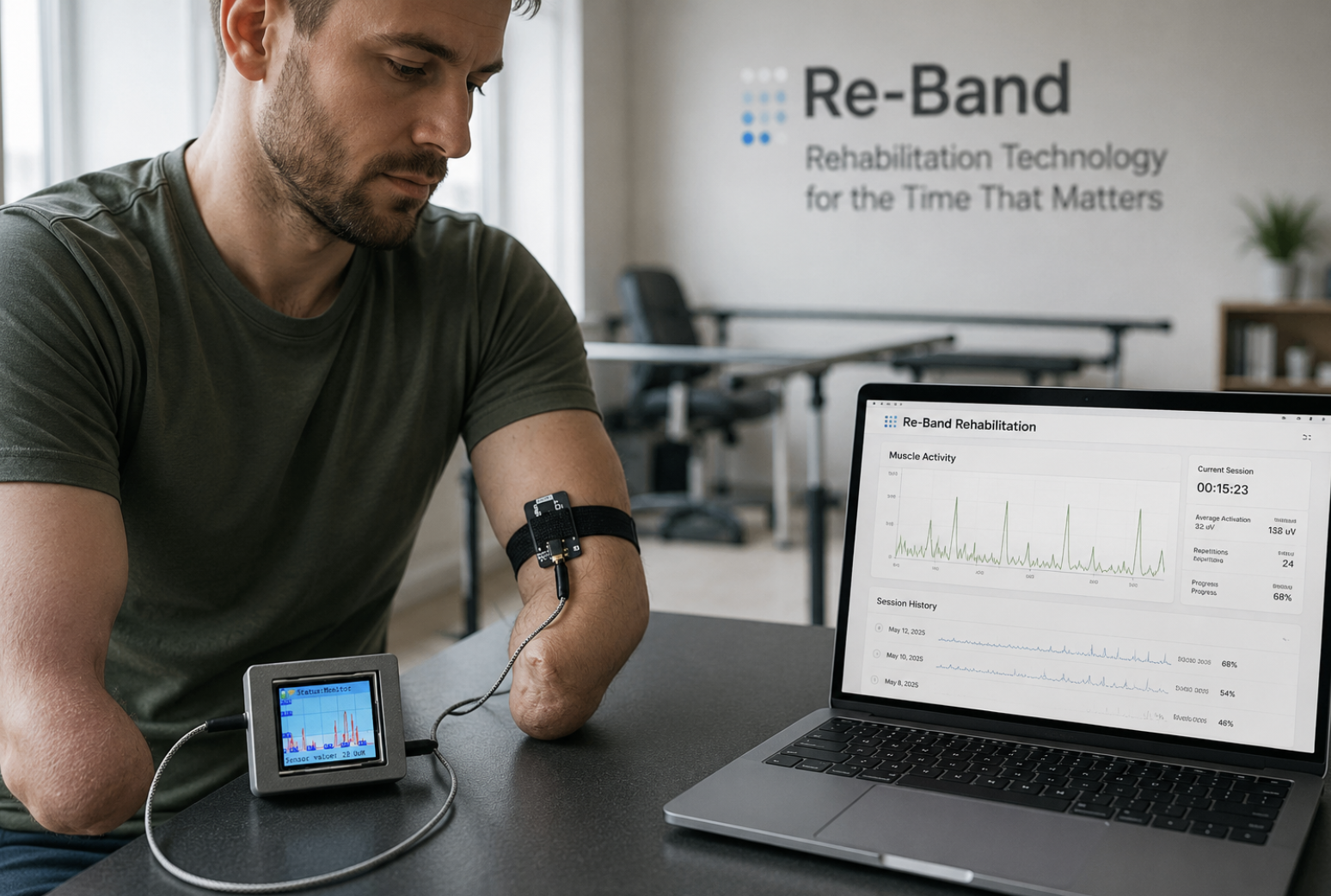
Re-Band: Building the Missing Link in Prosthetic Rehabilitation
A wearable rehabilitation device that helps amputees maintain residual muscle activity while waiting for a prosthesis. Developed inside HebronSoft’s Innovation Lab, Re-Band combines EMG sensing, real-time feedback, remote monitoring, and direct input from veterans, students, engineers, and rehabilitation specialists.
How DeveloperMedia Built a News Platform That Knows What Developers Actually Want to Read
HebronSoft helped DeveloperMedia create a personalized content intelligence system that understands developer interests, reading behavior, technical context, and domain-specific signals across a fragmented media ecosystem.
Pocket AI Therapist: From Symptoms to the Right Specialist in Minutes
An AI-powered symptom analysis platform that helps users understand potential conditions and connect with the right medical specialist faster.

 AI Assistant