


From “Stanford for Orphans” to Technology for Humanity: Liliya Valihun on the Ignited Podcast
Liliya Valihun of HebronSoft joined Inductive Automation’s Ignited podcast to share how an academy for orphans in Ukraine grew into an ecosystem using technology for social impact — from prosthetic solutions for Ukrainian veterans to open-source platforms addressing homelessness and global peacebuilding.
How Hebron Began: “Our First Home Was Not a Home for Us”
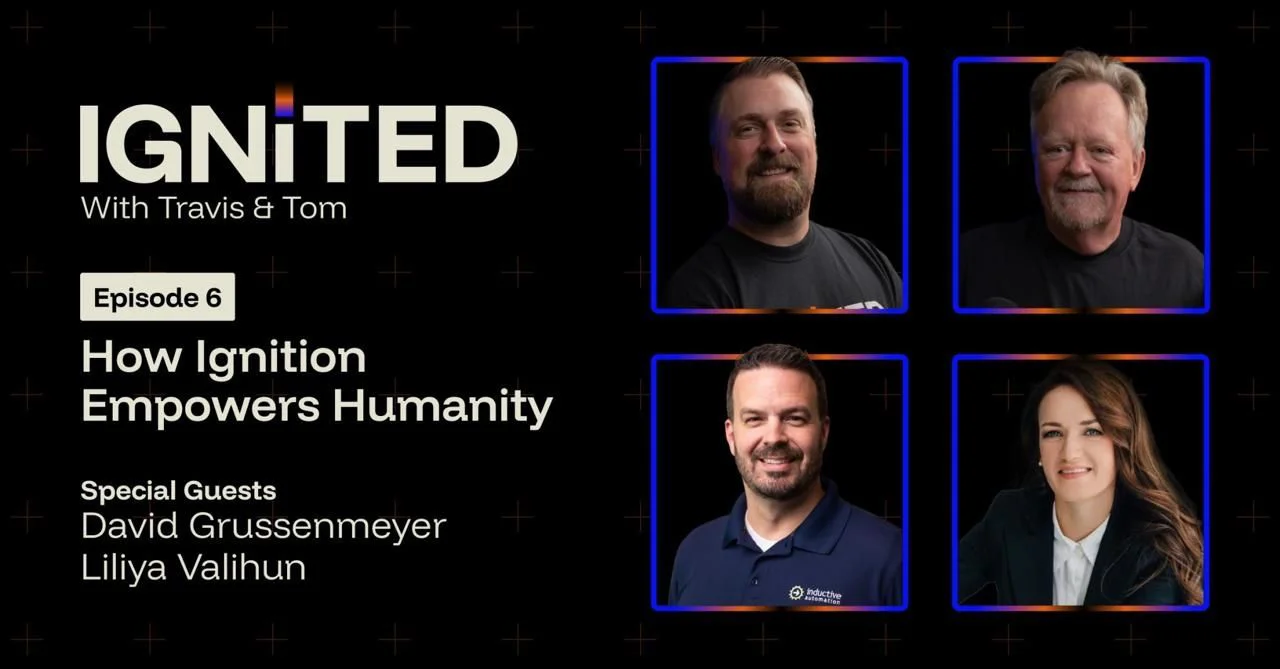
In Episode 6 of Inductive Automation’s Ignited podcast, “How Ignition Empowers Humanity,” Liliya Valihun of HebronSoft joined hosts Travis Cox and Thomas Burke and David Grussenmeyer, Director of Strategic Alliances at Inductive Automation, to explore how technology built for industrial automation can be applied to human challenges — from education and prosthetic technology in Ukraine to homelessness and global peacebuilding.
For Liliya, that story began in Ukraine.
After living and working in California, she and her family returned to Ukraine following Russia’s invasion in 2014. Instead of buying a home for themselves, they bought a large facility near Lviv for young people who lacked access to education and opportunity.
“Our first home was not a home for us. Today, we call it ‘Stanford for Orphans.’”
That facility became Hebron IT Academy — a place where students could live, study, receive psychological and healthcare support, learn technology, and build a path toward an independent future. HebronSoft was later created in part to help sustain the nonprofit Academy and provide internships and professional opportunities for its graduates.
Today, that model has expanded. Hebron also operates programs in Kyiv for young Ukrainians displaced by the war and those who have lost their homes, while its technology projects increasingly address problems created or intensified by the war.
How Hebron Uses Ignition Beyond Industrial Automation
One of the central themes of the conversation was Ignition, the industrial application platform developed by Inductive Automation, and what becomes possible when engineers look beyond its traditional applications in manufacturing and infrastructure.
HebronSoft uses Ignition in commercial projects across pharmaceuticals, life sciences, wastewater, and other industries, while Hebron IT Academy students train through Inductive University. The same knowledge and technology are also being applied to social-impact projects.
As Liliya explained during the conversation, innovation often begins when technology meets a real human problem.
Technology for Ukrainian Veterans
One example discussed on the podcast was Hebron’s work on prosthetic technology for Ukrainian soldiers.
Students used 3D printing and engineering to explore temporary solutions for people who have lost limbs and are waiting for permanent prostheses. The goal is not only technical: these solutions can help people begin adapting earlier and better understand what using a prosthesis will mean in everyday life.
For Liliya, the project began with one question:
“How can technology restore that independence and dignity for those soldiers?”
She describes it as a project of “double impact”: young people who have faced difficult circumstances themselves are using technology to build solutions for veterans who have lost limbs in the war.
Why Hebron Helped Make the Homeless Management System Open Source
Another part of the conversation focused on a project that began far from Ukraine.
The Homeless Management System originated from an effort to connect 13 Room In The Inn locations in Middle Tennessee. More than 150 engineers contributed to the project over roughly two and a half years, investing tens of thousands of hours to build a unified system for coordinating information, volunteers, programs, initiatives, and shelter intake.
Hebron later became involved in bringing the project to open source.
Liliya explained that homelessness is not only a housing problem. Organizations often struggle with fragmented data, limited visibility of resources, spreadsheets, and siloed systems that cannot communicate with one another.
For Hebron, making the platform open source was “not a business decision… it was a moral one.”
If technology built by a community of engineers can help one organization, its impact does not have to stop there. The goal, as Liliya described it, was impact multiplication rather than ownership.
From Homeless Services to Global Peacebuilding
That same technology is now finding another application.
HebronSoft is working with United Religions Initiative (URI), a global peacebuilding organization active in more than 130 countries, on a platform designed to strengthen communication between communities operating across different countries and existing systems.
Instead of starting from zero, the team is reusing technology originally developed for the Homeless Management System. According to Liliya, at least 25% of that codebase is being reused for the URI platform.
Technology originally created to coordinate homeless services in Tennessee is therefore becoming part of the infrastructure connecting an international peacebuilding network.
“It’s building not just smart factories, but it’s building smart communities.”
“Hebron Didn’t Wait for Permission”
Toward the end of the conversation, Thomas Burke captured an idea that connects many of these projects:
“Hebron didn't wait for permission. They asked what problem needed solving and then they built the answer.”
From technology education in Ukraine and prosthetic solutions for veterans to open-source infrastructure for nonprofits and a platform connecting peacebuilding communities around the world, the common starting point is a real problem that technology can help solve.
For Liliya, that impact does not have to begin at scale. It can start with one student, one community, or one small project — and grow from there. How Ignition Empowers Humanity …
She closed the conversation with a message from Ukraine:
“Hard times create strong people, and Ukrainians are very strong and resilient.”
Watch Liliya Valihun on the Ignited Podcast
Watch Episode 6 of Inductive Automation’s Ignited podcast, “How Ignition Empowers Humanity,” featuring Liliya Valihun and David Grussenmeyer with hosts Travis Cox and Thomas Burke.
Watch on YouTube →
You might be interested in
HebronSoft at ICC 2026: Preserving the Knowledge Manufacturing Can’t Afford to Lose
At ICC 2026, HebronSoft explored how manufacturers can preserve critical knowledge as experienced industrial automation professionals retire and AI transforms the industry.
HebronSoft Partners with One of Ukraine’s Largest Veteran Rehabilitation Centers
HebronSoft partners with one of Ukraine’s largest rehabilitation centers to connect Re-Band technology, veteran rehabilitation, and free tech education through Hebron IT Academy.
Rick Makos Named CEO of Hebron Holdings
Hebron announces the formation of Hebron Holdings and appoints technology executive Rick Makos as CEO, marking the group’s next stage of global growth.

 AI Assistant