


How Much Does a TMS Cost? Custom vs Ready-Made
How much does a TMS cost? Compare custom vs ready-made transportation management systems: first-year and 5-year costs, price factors and real TMS case studies.

Key takeaways
Originally published July 2021 · Updated October 2026
- In HebronSoft's 2021 cost model, a ready-made TMS was estimated at US$36,000–40,000 in the first year, potentially reaching US$900,000–1,000,000 over five years as the system scaled.
- The same historical model estimated custom TMS development at US$130,000–150,000 initially and US$300,000–400,000 over five years. These figures are not current market averages or guaranteed savings.
- The main price drivers are system type, number of users, carriers and customers, number of modules, integrations and implemented technologies.
- A third option is building on a pre-built TMS framework: custom where it matters, faster and cheaper than a ground-up build.
What Is a Transportation Management System (TMS)?
The cost of a transportation management system depends on more than the software itself. Licensing, integrations, fleet size, custom workflows and long-term maintenance all shape what a TMS will cost over time. Here's how to compare your options before choosing a solution.
A transportation management system (TMS) helps logistics companies plan, execute and track transportation operations, connecting shipments, carriers, drivers and business data in one system.
In the Descartes 2025 Transportation Management Benchmark Survey of 616 shippers and logistics providers, 81% called transportation management a competitive asset and 80% plan to increase spending on TMS technology. Yet only 17% are fully automated, and more than a third still rely heavily on manual processes.
The global TMS market was valued at about US$18.7 billion in 2025, with North America accounting for 39% of the market, according to Fortune Business Insights.
What does the right TMS include?
Logistics has many variables adjusted to diverse goals. This is why it's hard to describe an ideal system that corresponds to expectations of all business participants. On the other hand, companies distinguish some basic features a good TMS should include:
1. Contract management: A TMS system speeds up your contracts and agreements, sends alerts when agreements are about to expire, and enables your managers to track contracts in real time. TMS systems improve your document flow.
2. Vehicle park management/freight settlement: A TMS system keeps vehicles, drivers and loads in one place, tracks freight in real time, and calculates and settles payments with carriers and drivers without manual spreadsheets.
3. Timely reports and analytics: TMS systems help business owners to increase their company efficiency through up-to-date analytics built into the software. Get regular reports on shipment data, tariffs, market prices, etc. to enhance your services.
As for the other services, they are usually customized, depending on certain business needs and requirements.
Cloud vs On-Premise TMS: What's the Difference?
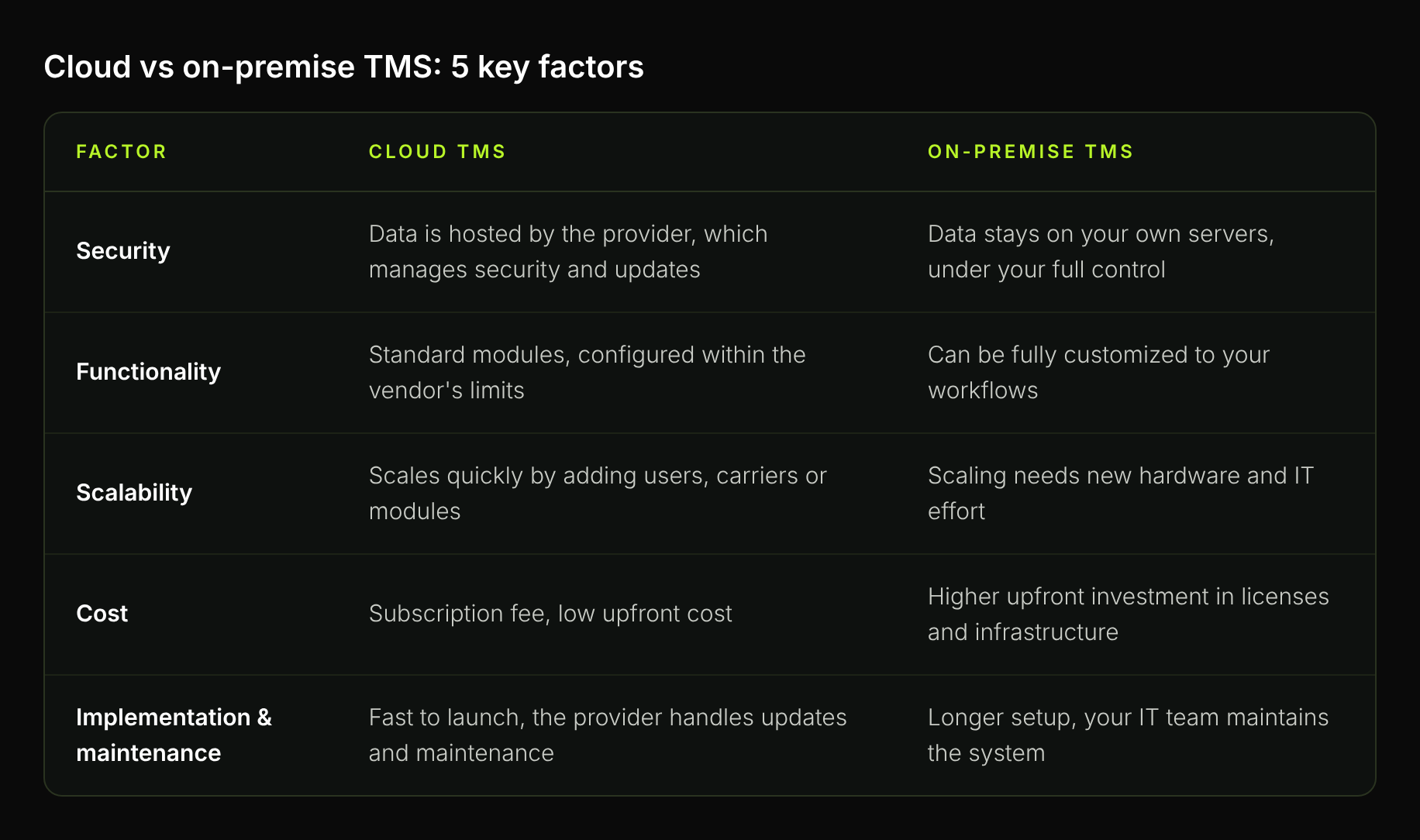
Such software is divided into two key types: cloud and on-premise ones. Today, cloud leads: cloud deployments generated 61% of TMS market revenue in 2025 and remain the fastest-growing segment, according to Mordor Intelligence. On-premise systems are still used where companies need full control over data and infrastructure.
What are the differences between those types of Transport Management Systems? The comparison is usually based upon 5 factors:
Key Stages of Custom TMS Development
The process of software implementation requires the following stages:
1. Scoping. You need to identify all your expectations and highlight business needs a system should correspond with. A development team offers some ideas, discusses the functionality to come up with the solution that satisfies both sides.
2. Project start. When all the details are discussed thoroughly, a team starts to develop software in correspondence with terms and conditions.
3. Implementation. A development team implements the system to your business, setting up all the processes. Such a stage requires testing services as well.
4. Maintenance and support. When the agreement includes this stage, business owners get constant maintenance from a provider (developing) company.
TMS Technology Trends
Transportation Management System benefits are evident but TMS solutions continue to develop further. The following trends are in-demand now:
- Blockchain. This technology builds up a chain of commands, and no one is able to make changes within a chain. Blockchain-based TMS solutions provide the highest protection and may serve as ready-made payment ecosystems.
- Big Data. The technology enables business owners to leverage giant data volumes to predict the load of storehouses, shipping time, and other important factors.
- AI and Machine learning. Artificial Intelligence is about to become a synonym of progress, and AI-based TMS systems effectively identify issues and adjust to any conditions instantly. According to the Descartes 2025 survey, 96% of shippers and logistics providers already use generative AI, most often for data entry (41%), route and load optimization (39%) and freight forecasting (35%).
Therefore, an up-to-date TMS management system needs to be able to add innovative and revolutionary technologies as they are available.
How Much Does TMS Implementation Cost?
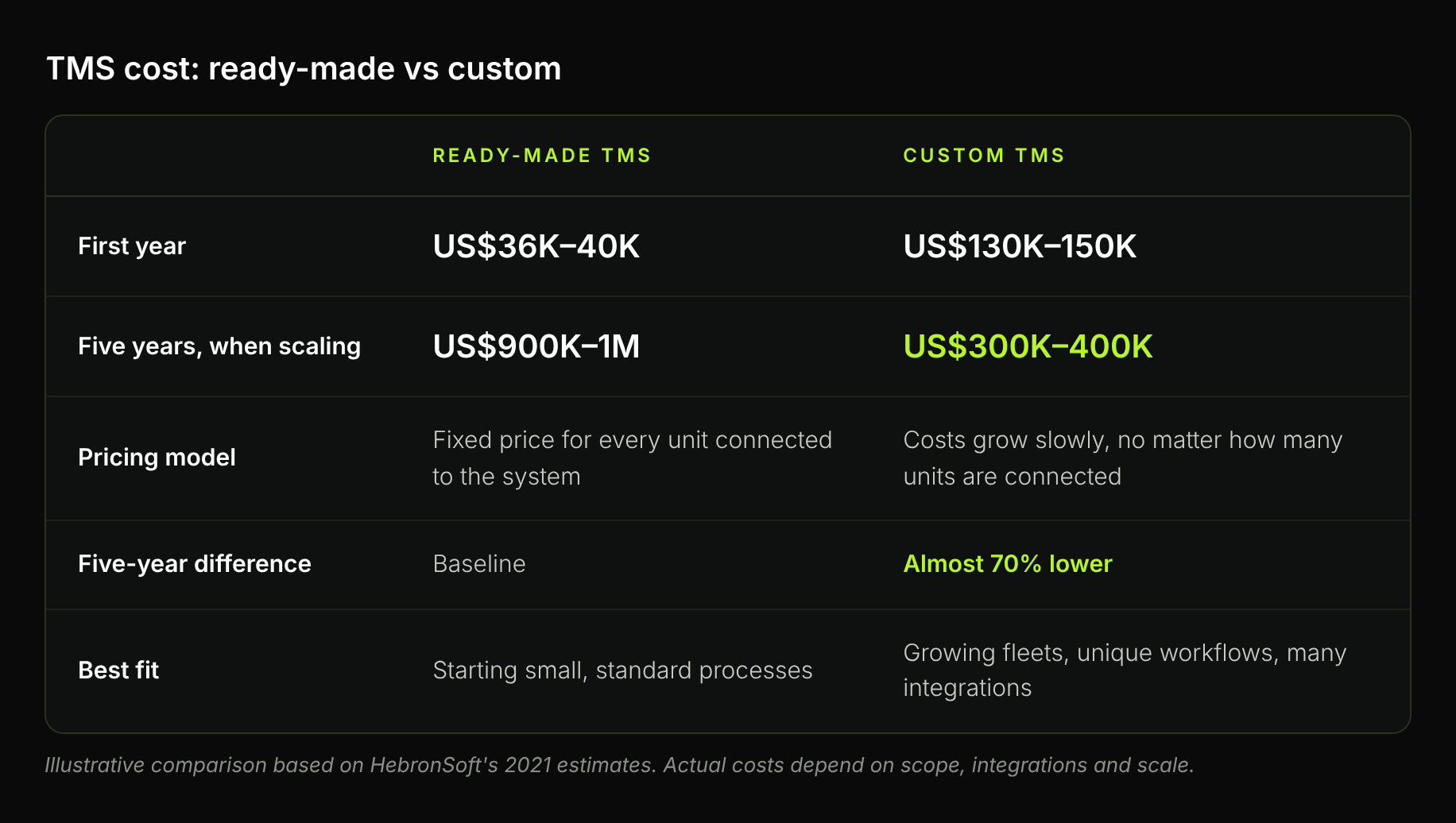
The cost of implementing a TMS depends on whether you choose a ready-made solution or custom development. In HebronSoft's 2021 cost model, a ready-made TMS was estimated at US$36,000–40,000 in the first year, with potential five-year costs of US$900,000–1,000,000 as the system scaled.
Custom TMS development required a higher initial investment of US$130,000–150,000, but the model projected lower five-year costs of US$300,000–400,000. These historical estimates illustrate how different pricing models can affect total cost of ownership — not current market averages or guaranteed savings.
The table below compares the first-year and five-year costs in HebronSoft's historical model.
CASE STUDY · TRANSPORTATION & LOGISTICS
Motion TMS: Custom-Built for USKO Logistics, Without Starting from Scratch
USKO Logistics, a nationwide US carrier, had its dispatch, accounting, finance and operations teams working across disconnected systems. Previous attempts to develop a custom TMS hadn't delivered the solution the company needed.
HebronSoft took a different approach. We mapped the company's workflows, designed the system architecture and built Motion TMS using a proven framework with ready-made modules — adding custom functionality where USKO needed it.
The result was a TMS tailored to the company's operations, with a faster development process and lower costs than building everything from scratch.
What Motion TMS brings together:
- Dispatch, load management and freight tracking
- Driver mobile app, documents and communication
- Accounting, invoicing and settlements
- Freight brokerage, safety and compliance
- EDI, QuickBooks and NetSuite integrations
“Their ability to change rapidly and advise us with things that could be changed or done differently distinguishes them.”
— Alice Dutova, Logistics Director, USKO Logistics
See How We Built It Smarter →

7 Factors That Affect TMS Pricing
In our 2021 cost model, TMS budgets ranged from US$36K to US$150K in the first year and from US$300K to US$1M over five years. These historical estimates are not current market averages. Actual costs depend on the following seven factors:
- Type of system: Cloud or on-premise deployment, ready-made software or custom development.
- Number of internal and external users: The number of employees, drivers, dispatchers and partners who need access.
- Number of carriers: How many transportation providers and carrier accounts the system must support.
- Number of customers: The number of customer accounts, their workflows and reporting requirements.
- Number of software modules: Dispatch, load management, tracking, accounting, brokerage, analytics and other features.
- Implemented technologies: AI, machine learning, predictive analytics and other capabilities that require additional development.
- Integrations: Connections with accounting, EDI, ERP, telematics and partner systems. Every external system has its own API, data format and rules, making integrations an important cost driver.
Before choosing a TMS, map your workflows, required integrations, expected transaction volumes and growth plans. These details will help your development partner estimate both implementation costs and long-term ownership expenses.
CASE STUDY · INTEGRATIONS AT SCALE
40+ lenders, one engine, an offer in about 60 seconds
When a system has to talk to dozens of external platforms in real time, integrations become the product. HebronSoft built the financial decisioning layer behind a leading North American vehicle marketplace, connecting 40+ lenders, credit bureaus, tax engines and dealer systems.
Shoppers get a real, financeable offer in about 60 seconds, and the client reported a 15–20% increase in direct sales after launch.
See the Architecture Behind the Results →

Building a TMS with HebronSoft
Your TMS should work for your operations, not the other way around.
HebronSoft designs and builds transportation management systems that connect dispatch, drivers, accounting and partners in one workflow.
We start with your requirements and system architecture, reuse proven TMS modules where they make sense, and build custom functionality where it matters. That's the approach we took with Motion TMS for USKO Logistics — without starting from scratch.
You work directly with the engineers building your solution, with IP ownership and source code rights defined clearly in your agreement.
Planning a TMS? Explore how we help logistics companies build systems that fit their operations — and their growth.
See What We Build for Logistics →
FAQ
Frequently asked questions about TMS cost
How much does a TMS system cost?
TMS pricing depends on licensing, users, modules, integrations and customization. In HebronSoft's 2021 cost model, first-year estimates ranged from US$36,000–40,000 for ready-made software to US$130,000–150,000 for custom development. These are historical estimates, not current market prices.
Is a custom TMS cheaper than a ready-made one?
Upfront, no. Over time it can be, if your system scales: ready-made pricing usually grows with every connected unit, while custom costs grow more slowly. The real difference depends on scale, licensing, support and integrations.
Is a custom TMS cheaper than a ready-made one?
Not necessarily. Custom development typically requires a higher initial investment, but may offer lower long-term costs for businesses with complex workflows or extensive integration needs. The total cost depends on the licensing model, maintenance, scalability and scope of development.
What affects the price of a TMS the most?
System type, number of users, carriers and customers, number of modules, implemented technologies such as AI, and integrations with accounting, EDI, ERP and partner systems.
Can a TMS integrate with QuickBooks, NetSuite and EDI?
Yes. Motion TMS, built by HebronSoft, integrates with EDI, QuickBooks and NetSuite.
Is cloud or on-premise TMS more common today?
Cloud. Cloud deployments generated 61% of TMS market revenue in 2025 and are the fastest-growing segment, according to Mordor Intelligence.
You might be interested in
HebronSoft at ICC 2026: Preserving the Knowledge Manufacturing Can’t Afford to Lose
At ICC 2026, HebronSoft explored how manufacturers can preserve critical knowledge as experienced industrial automation professionals retire and AI transforms the industry.

Rick Makos Named CEO of Hebron Holdings
Hebron announces the formation of Hebron Holdings and appoints technology executive Rick Makos as CEO, marking the group’s next stage of global growth.

HebronSoft Partners with One of Ukraine’s Largest Veteran Rehabilitation Centers
HebronSoft partners with one of Ukraine’s largest rehabilitation centers to connect Re-Band technology, veteran rehabilitation, and free tech education through Hebron IT Academy.

 AI Assistant