


How PN Medical Turned 40 Years of Clinical Knowledge Into a Scalable Platform
How do you digitize 40 years of peer-reviewed clinical evidence without disrupting a device business already serving two million people?
That was the challenge HebronSoft solved for PN Medical.
At a Glance
- 4+ years — in production partnership
- 2M+ — end users supported globally
- Mayo Clinic — clinical study enabled by the data infrastructure HebronSoft built
- 5-platform — healthcare ecosystem on one clinical data foundation
- 99.95% — uptime SLA
The Company Behind the Devices
The Pioneer of Respiratory Muscle Training
Key Facts
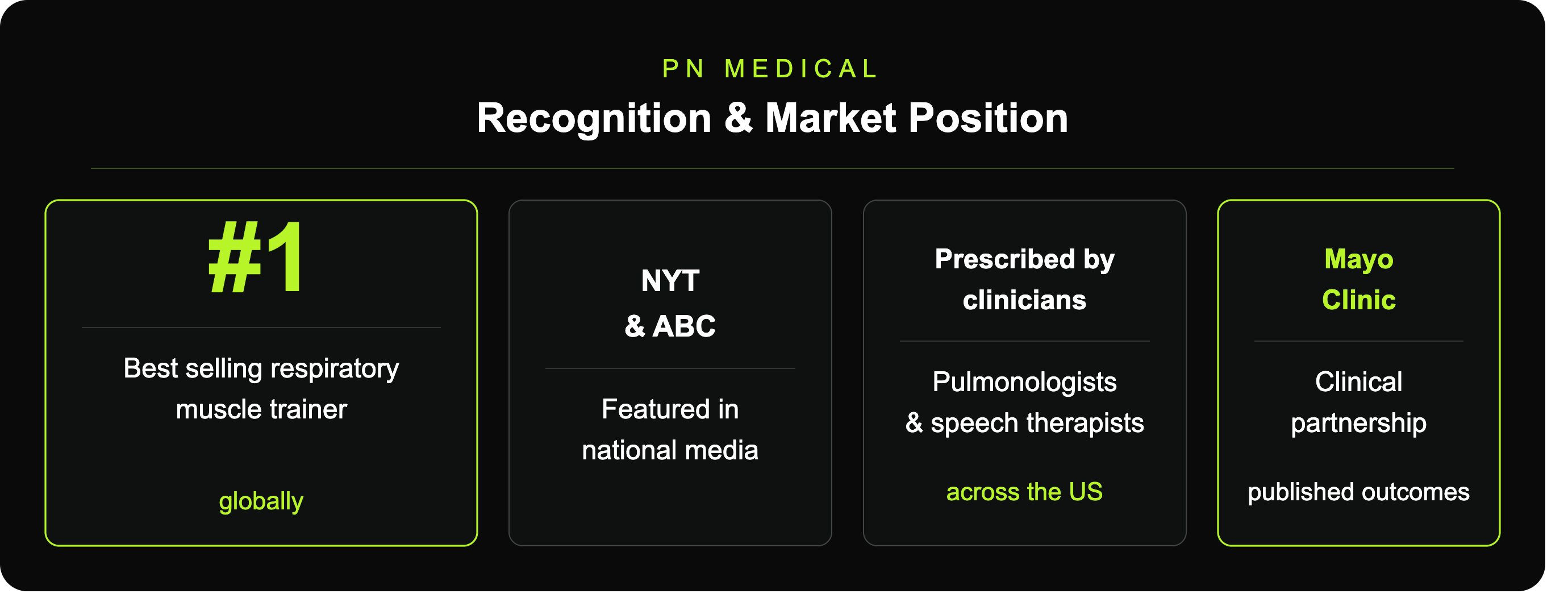
- Founded: 1980 · 44 years of medical science
- Users: 2,000,000+ people helped to breathe better globally
- Devices: Breather Coach, Breather Fit, Breather Voice, Breather Med
- Regulatory: FDA Class 1 device · Medicare reimbursable · HSA/FSA eligible · HIPAA-aware data handling
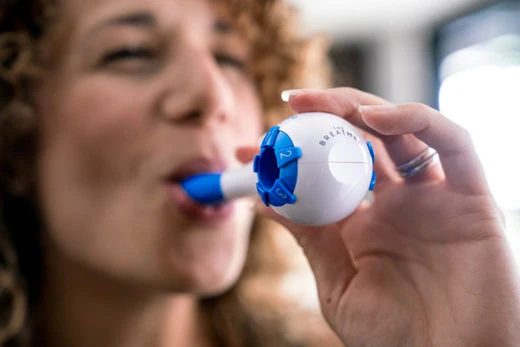
PN Medical created the world’s first combined inspiratory and expiratory respiratory muscle trainer — a device that works like resistance training for the lungs, strengthening the diaphragm and intercostal muscles through controlled airflow resistance. No drugs, no electronics in the core device. Just progressive overload applied to muscles that most people never think to train, grounded in 44 years of medical science.
The clinical range spans four distinct use cases: patients recovering from COPD, chronic heart failure, Long COVID, and stroke rehabilitation on one end — Olympic athletes, Special Operations soldiers, and professional sports teams seeking VO₂ max improvement on the other. Pulmonologists prescribe it. Speech therapists use it for dysphagia rehabilitation. The same underlying mechanism serves populations with almost nothing else in common.
After four decades of clinical validation and two million users across hospital systems, home health, and elite athletic programs, PN Medical had built something rare: a device category with genuine evidence behind it. The next challenge was digital. The company needed infrastructure that could support clinical trials, serve clinicians and coaches simultaneously, and scale what the devices had already proven.
The Challenge
Growth Exposed the Limits of the Existing Infrastructure
Rapid growth in the device base created pressure on every part of the digital operation. The existing system had been built for an earlier stage of the business — it wasn’t designed to handle multiple user types operating simultaneously, or to support the clinical trial data management that institutional partnerships required.
Specific Constraints
- Legacy system required full-scale upgrades across back-office administration, data layer, and mobile
- Multiple simultaneous user types: admins, clinicians, coaches, patients, athletes
- No clinical trial data infrastructure — a prerequisite for any institutional research partnership
- Device data heterogeneity across platforms
- Multi-platform fragmentation: web portals and mobile
- Regulatory compliance requirements: HIPAA-aware data handling, FDA audit trail standards
The clinical side needed its own infrastructure: de-identified records, audit trails, study protocol management, and standardized outcome measurement. The consumer side needed a different experience entirely — progress tracking, protocol adherence, behavioral coaching. The athletic side needed team management and performance analytics. All of this had to run on a unified platform without those worlds bleeding into each other.
Inside the Room
A Contained Task Revealed a Strategic Opportunity
HebronSoft was initially brought in for a focused task: enabling the digital experience for owners of Breather Coach and Breather Fit devices. The scope was clear and contained.
As the discovery process unfolded, PN Medical recognized something larger. The company had 40 years of clinical evidence and a growing device base — and the right digital infrastructure could unlock an entirely new dimension of the business: Clinical Trials, Clinical Evidence generation, and institutional research partnerships at the level of Mayo Clinic. That wasn’t a scope change. That was a strategic decision to move from a device company to a clinical evidence platform.
PN Medical chose to build for that opportunity. The entire engagement that followed was shaped by that decision.
Every architectural decision had to serve two realities simultaneously: a device business already serving two million people that could not be disrupted, and a clinical evidence layer being built from scratch to meet the regulatory standards that institutional research demands.
“The hardest part wasn’t building the portals. It was making sure the data layer could hold up under the requirements of a clinical trial — where the integrity of every record matters for regulatory purposes. That’s a different standard than typical product development.”
— Bohdan Bilas, CTO, HebronSoft
What We Built
A Multi-Platform Clinical Evidence Ecosystem
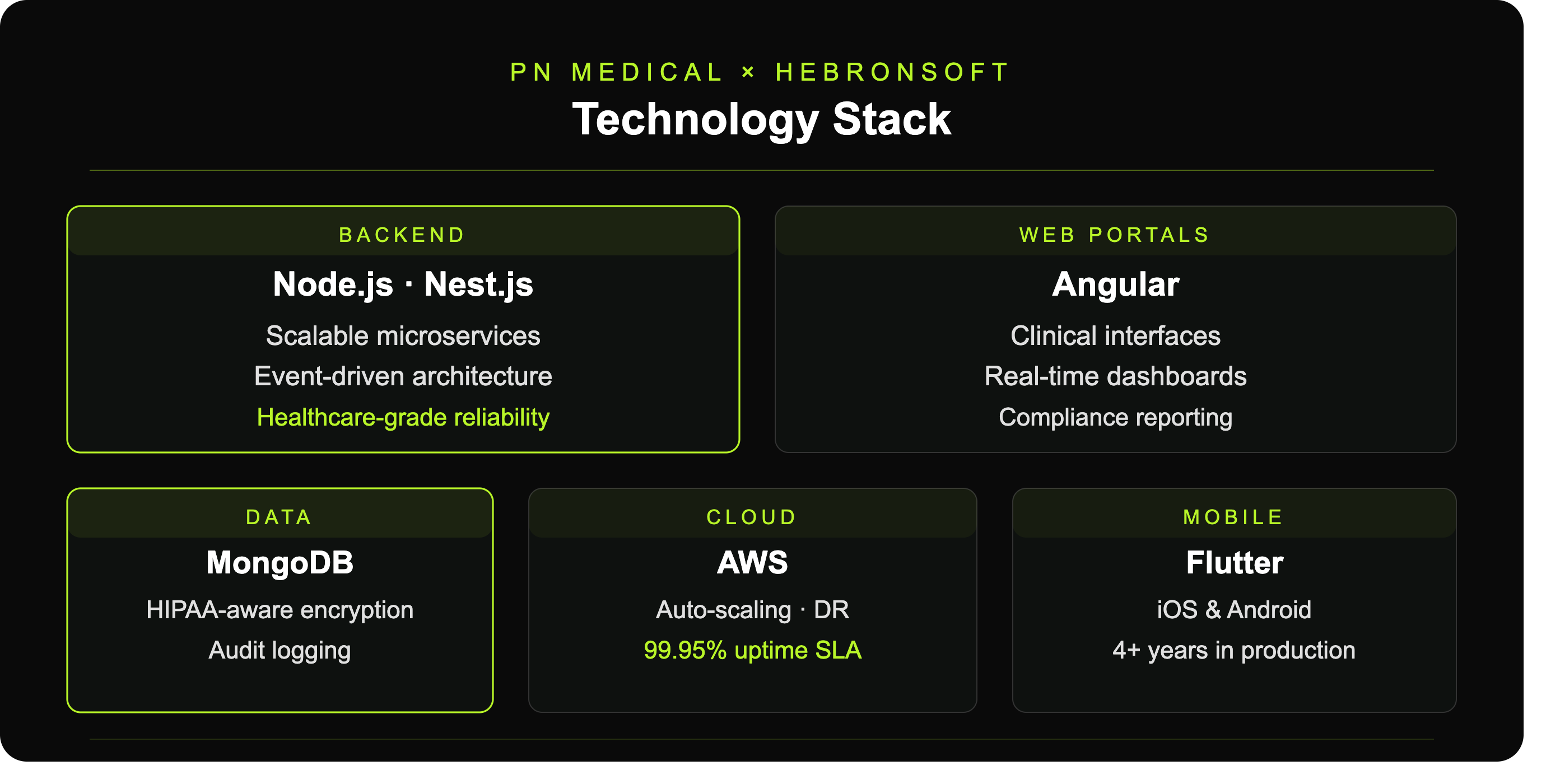
HebronSoft designed and developed a comprehensive clinical evidence ecosystem covering every corner of PN Medical’s operations. The architecture starts with a single clinical data foundation — one source of truth for device telemetry, patient records, and clinical outcomes — with four distinct user experiences built on top of it, each serving a completely different population without any of those worlds bleeding into each other.
Clinical — Clinicians & Hospitals
- Medical portal for patient monitoring, care plan creation, and clinical trials management
- Clinical Evidence data layer: de-identified records, HIPAA-aware architecture, audit trails for FDA
- Study protocol management, enrollment tracking, compliance monitoring
- Role-based access for admins, clinicians, and health coaches — each with correct data visibility
- Plan Builder: customizable breathing exercise protocols distributed to patient cohorts
- AI-flagged non-adherence triggers for coach intervention
- Automated outcomes reporting for clinicians and researchers
Consumer — Patients & Home Health
- Device integration and real-time progress tracking
- Protocol adherence monitoring with behavioral feedback
- Educational content for long-term engagement and health literacy
Athletic — Coaches & Athletes
- Performance optimization protocols and training assignment
- Team management and athlete progress analytics
- Entirely separate user journey — same underlying data infrastructure
Mobile — iOS & Android
- Native health coaching apps designed and developed end-to-end
- Full migration from Ionic to Flutter — improved performance without disrupting users in production
- Real-time device data sync, progress dashboards, adherence tracking
- 4+ years in production
Security and compliance architecture were built into the system from the start, not retrofitted. This includes HIPAA-aware data handling, FDA-compliant audit trails, de-identified records for clinical trial use, and role-based access controls enforced at the data layer. HebronSoft operates under ISO/IEC 27001:2022 certification, covering client data handling, infrastructure security, and access controls across the full engagement.
Clinical Validation
The Data Layer Made Mayo Clinic Possible
The clinical evidence infrastructure HebronSoft built wasn’t a feature — it was the prerequisite for the Mayo Clinic partnership. Without a platform capable of managing de-identified records, standardized device telemetry, and compliant audit trails, the study couldn’t have proceeded.
The published results from the Mayo Clinic study validate what PN Medical’s clinical team had observed for years. The platform gave those observations the data infrastructure to become evidence.
Mayo Clinic Study Results
- -7% — Systolic blood pressure reduction
- -3% — Diastolic blood pressure reduction
- +45% — Increase in blood flow and circulation
- -18% — Reduction in chronic stress markers
Note: Clinical outcomes reflect device efficacy validated through the Mayo Clinic study. Results are attributable to PN Medical’s Breather devices, enabled by the data infrastructure HebronSoft built.

Why This Matters
PN Medical already had the clinical evidence. Four decades of it. What the company needed was a digital infrastructure capable of transforming that evidence into something institutional partners could work with, clinicians could trust, and patients across every market could access.
That’s what this partnership delivered — not a set of portals, but the infrastructure that allowed a device company to become a clinical evidence platform. The Mayo Clinic study was possible because the data layer was built to clinical standards. The platform serves hospitals, home health patients, and elite athletes simultaneously because the architecture was designed for that from the start, not adapted to it later.
What We Learned
Three decisions that defined the architecture
1. Discovery scope protection is engineering work, not project management
HebronSoft was brought in to solve one problem. Discovery revealed a completely different problem at a completely different scale. That gap — between what a client articulates at the start and what the system actually needs to do — is where most healthcare software projects fail. In regulated environments, building the wrong architecture means rebuilding under compliance pressure later. The discovery investment at the start of the PN Medical engagement protected both the client and the delivery team from that outcome. It is now a structured phase in every clinical project we take on.
2. Role-based access is an architecture decision, not a feature
The PN Medical ecosystem serves five distinct user types — admins, clinicians, health coaches, patients, and athletes — each needing a different slice of the same underlying data. In healthcare, getting this wrong isn’t a UX problem. It’s a HIPAA problem. Role-based access control was designed and enforced at the data layer from day one. That decision determined how the entire data model was structured, how clinical trial records were isolated, and how the same platform could serve a hospital clinician and a competitive athlete without either having visibility into the other’s data.
3. Migrating a live mobile stack is a different problem than building from scratch
The migration from Ionic to Flutter happened while the apps were in active use. There was no downtime window. Every change shipped incrementally, with the previous stack running in parallel until the new one was verified in production. A migration is complete not when the new code is written, but when the old code can be safely removed without user impact. This established the migration methodology we now apply to all production mobile transitions.

Meets deadlines, stays within budget, and truly cares about our success
Our company contracted HebronSoft in 2018 to do a multi-year project to build a consumer and medical portal. HebronSoft meets deadlines, stays within budget, and they truly care about our success and the extra mile every time we ask.


You might be interested in
EON Lab by OneVital: An App That Explains Your Health, Not Just Tracks It
How HebronSoft designed and engineered the AI, scoring models, wearable integrations, and mobile applications behind EON Lab.
Re-Band: Building the Missing Link in Prosthetic Rehabilitation
A wearable rehabilitation device that helps amputees maintain residual muscle activity while waiting for a prosthesis. Developed inside HebronSoft’s Innovation Lab, Re-Band combines EMG sensing, real-time feedback, remote monitoring, and direct input from veterans, students, engineers, and rehabilitation specialists.
From Automation to AI: Our Partnership with InflexionPoint
Since 2022, our teams have worked together across industrial automation, life sciences, pharmaceuticals, and advanced manufacturing, combining deep domain expertise with software engineering to help manufacturers modernize operations and build the next generation of connected, data-driven facilities.

 AI Assistant