


Halo: When Help Can’t Wait, the Drone Arrives First — Inside the Platform That Makes It Possible
What does it take to add drone-assisted safety to a campus or facility without rebuilding infrastructure for every new client?
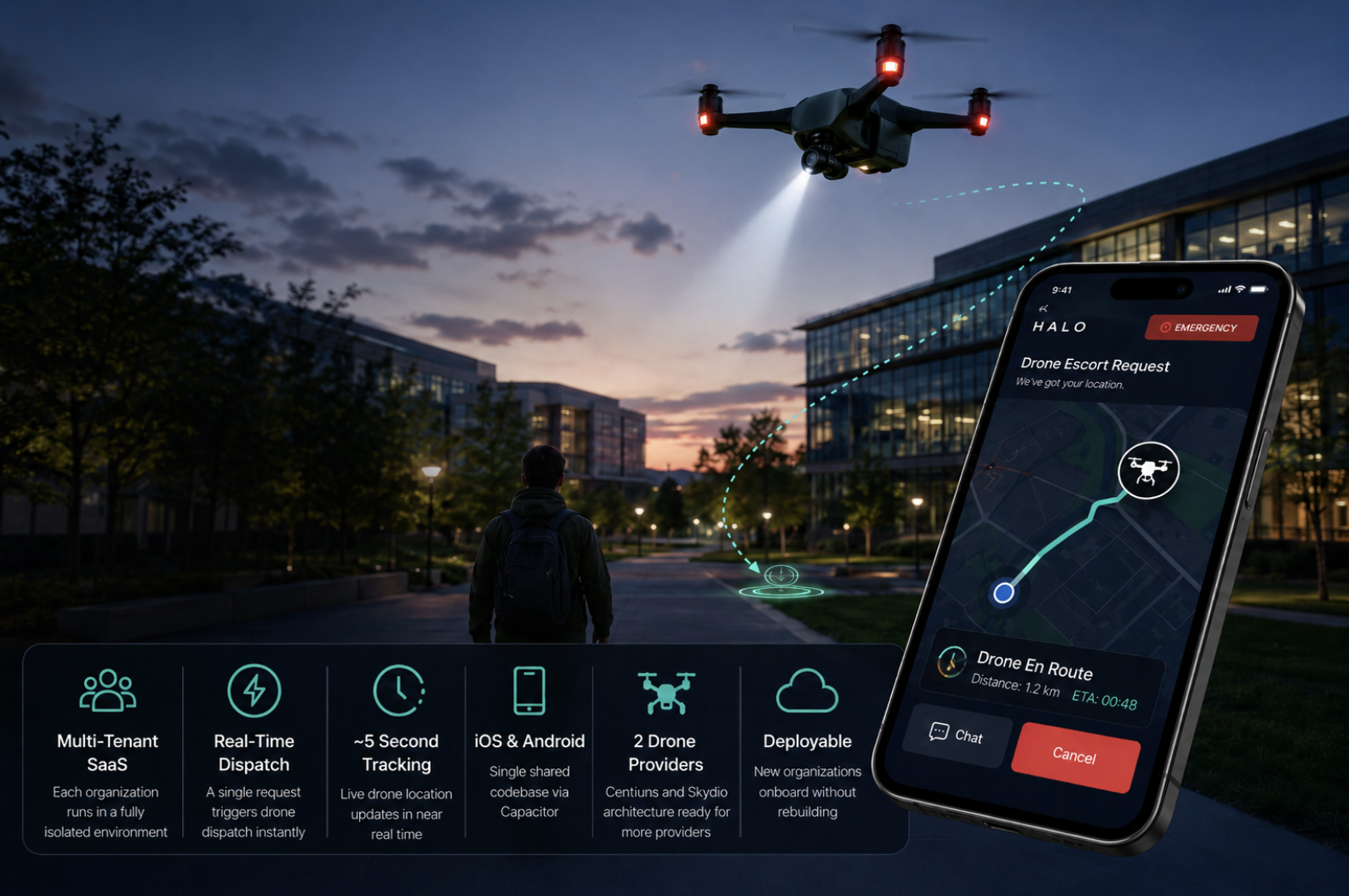
CoreValueTec came to HebronSoft with that question. The result is Halo — a multi-tenant safety platform where one button press triggers a coordinated drone response, and each new organization onboards through configuration rather than custom development.
The Company Behind Halo
Drone-Assisted Safety as a First Response Layer
Key Facts
- Client: CoreValueTec
- Product: Halo — real-time drone escort and safety monitoring platform
- Environments: Campuses, corporate facilities, controlled business areas, private zones
- Drone providers: Centinus (primary), Skydio (beta)
CoreValueTec is building a new category of safety infrastructure: autonomous drone support that can act as a visible first-response layer for campuses, corporate facilities, and controlled environments. The business model is built on deployability — a university campus, a corporate headquarters, and a private facility each run Halo as their own isolated environment, with their own users, credentials, and operational zones, while sharing the same underlying platform. New organizations onboard through configuration, not through rebuilding.
The Challenge
The Drone Is Only One Part of the System
The core challenge was not drone integration. It was orchestration: making authentication, tenant routing, incident creation, operator communication, telemetry processing, and real-time subscriptions all work together as a single coordinated experience — fast enough and reliable enough for emergency situations.
Tenant isolation had to be real, not simulated. Each organization needed its own AWS stack, its own Cognito User Pool, its own configuration, and its own drone provider credentials. A shared environment would have been faster to build but would not support the organizational separation the business model required.
Drone provider flexibility mattered from the start. A single integration would have simplified delivery but locked the client into one operational partner. The architecture needed to treat Centinus and Skydio as replaceable components — and leave room for additional providers in the future.
A polling mechanism works for demos. For a person waiting for a drone in an emergency, it does not. The platform needed a location update cycle of approximately five seconds, delivered reliably to both the mobile app and the operator console simultaneously.
Inside the Room
Hiding Operational Complexity Behind a Simple User Experience
For the person using Halo, the experience is a single button press. Behind that button, the system is doing dozens of things simultaneously: authenticating the user against their organization’s tenant, validating their zone access, creating an incident in the drone management platform, opening a conversation with the user’s location as the first context message, routing the incident to available operators, and beginning the telemetry pipeline so the drone’s position flows back to the mobile app in near real time.
The product decision that shaped the architecture was to start from the user’s moment of need and work backward. What does the system need to have already completed before the person opens the map? What must happen in the background the instant they submit a request? What does the operator need to see immediately to respond effectively?
“Once we stopped thinking about this as a drone integration project and started thinking about it as a safety orchestration platform, the architecture became clearer. The drone is only one part of the experience. The real challenge is trust: the user must trust that the request was received, the operator must trust the mission data, and the organization must trust that each tenant is isolated and secure.”
— HebronSoft Engineering Team
What We Built
A Multi-Tenant Real-Time Safety Orchestration Platform
HebronSoft designed and developed Halo end-to-end: product architecture, UX, full-stack development, drone system integrations, real-time telemetry pipelines, and cloud infrastructure.
Safety Workflow & User Roles
- Subscribers: request standard or emergency drone escorts, track drone on live map, communicate with operators via in-app chat
- Pilots: respond to incidents, manage drone missions through Centinus or Skydio operational consoles
- Admins: manage users, geographic zones, drone configuration, and organization-level settings
- Emergency request flow: high-priority dispatch with direct operator communication for real-time situational handoff
Real-Time Orchestration
- Single request triggers coordinated chain: tenant validation, incident creation, conversation setup, operator routing, telemetry stream activation
- AppSync subscriptions push drone location updates to mobile app at ~5 second intervals
- Skydio telemetry processed via WebSocket — location written to DynamoDB, pushed to app through AppSync
- Centinus webhooks handle incident lifecycle: creation, updates, deletion, operator acknowledgment
- Google Maps with marker clustering for live drone visibility and operational zone display
Multi-Tenant Infrastructure
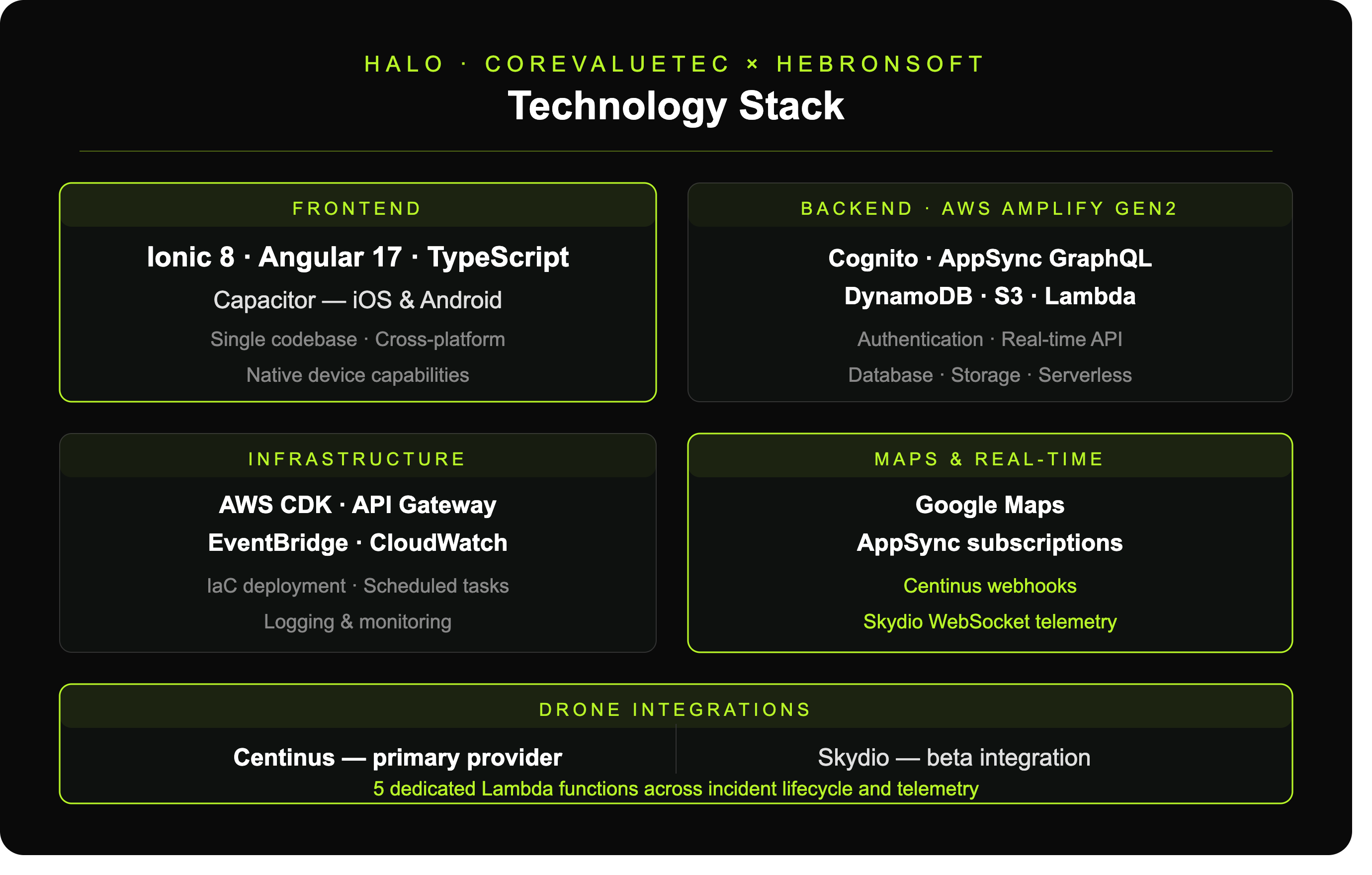
- Amplify Stack: Cognito authentication, AppSync GraphQL API, DynamoDB, S3, Lambda — core platform
- Admin Stack: privileged operations requiring direct Cognito access (secure user deletion, admin configuration)
- Integrations Stack: 5 Lambda functions — Centinus incident creation, incident updates and deletion, Skydio webhook processing, Skydio WebSocket telemetry, conversation maintenance
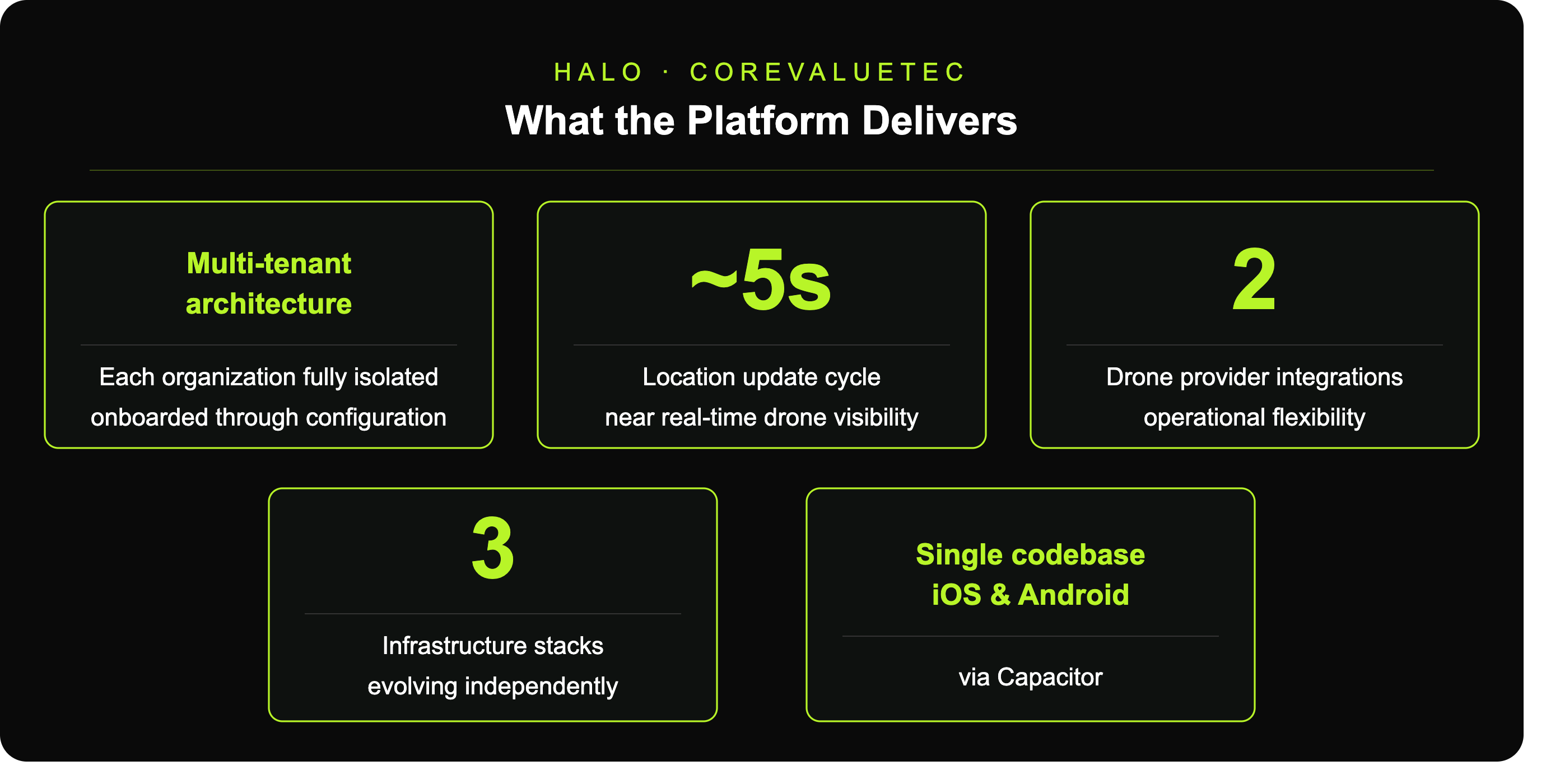
- Each tenant: dedicated AWS stack, isolated Cognito User Pool, separate configuration and drone credentials
- AWS CDK, API Gateway, EventBridge for scheduled maintenance, CloudWatch for logging and monitoring
Mobile Applications
- Ionic 8, Angular 17, TypeScript with Capacitor — iOS and Android from a shared codebase
- Real-time map interface with drone visibility, operational zones, and emergency request capabilities
- In-app communication channel between users and drone operators throughout escort missions
Business Impact
Safety as a Service — Deployable Across Organizations
The platform CoreValueTec now operates is not a custom build for one environment. It is a deployable service. A new campus or corporate facility can be onboarded as a tenant through configuration — its own isolated stack, its own user base, its own drone provider credentials — without rebuilding the platform.
That architecture directly supports the business model of selling drone-assisted safety across multiple organizations.
From the user perspective, the operational complexity of coordinating a live drone escort is entirely invisible. A subscriber in a moment of need sees the drone moving toward them on a map. The operator sees the full incident context. The administrator controls the environment.
What We Learned
In safety software, simplicity for the user means complexity in the architecture
The simpler the user experience has to be in a moment of emergency, the more the system has to do invisibly. Every step that a person should not have to think about — authentication, tenant routing, incident creation, operator notification — has to be pre-orchestrated so it happens without delay the instant a request is submitted. Building that kind of invisible coordination requires treating the user journey as the primary constraint, and designing the architecture around it rather than the other way around.
Tenant isolation built in from day one also proved to be the right decision at the architecture level. A shared environment would have been faster to build initially, but each new organization would have required workarounds rather than clean configuration. The cost was paid once at the architecture level rather than repeatedly at the deployment level.

Versatility to be placed in multiple areas of existing projects quickly
Hebronsoft's developers have helped us greatly due to their versatility and ability to be placed in multiple areas of existing projects quickly.


You might be interested in
EON Lab by OneVital: An App That Explains Your Health, Not Just Tracks It
How HebronSoft designed and engineered the AI, scoring models, wearable integrations, and mobile applications behind EON Lab.
How We Built the Financial Decisioning Layer Behind a Leading North American Vehicle Marketplace
How HebronSoft engineered the decisioning, integrations, and deal-math systems that turn thousands of vehicles and 40+ lenders into real, financeable offers in under 60 seconds.

From Automation to AI: Our Partnership with InflexionPoint
Since 2022, our teams have worked together across industrial automation, life sciences, pharmaceuticals, and advanced manufacturing, combining deep domain expertise with software engineering to help manufacturers modernize operations and build the next generation of connected, data-driven facilities.

 AI Assistant