


EON Lab by OneVital: An App That Explains Your Health, Not Just Tracks It
Wearable devices generate more health data than users know what to do with. The gap is not collection — it’s interpretation. How do you build a system that doesn’t just surface biometric data, but explains what it means in the context of that specific person’s history, patterns, and behaviors across multiple health dimensions simultaneously?
That was the product challenge OneVital brought to HebronSoft. The result is EON Lab — a health intelligence platform built from the ground up, with HebronSoft responsible for the full technical scope: AI and machine learning architecture, scoring engine, personalized assistant, wearables integration, and native mobile apps for iOS and Android.
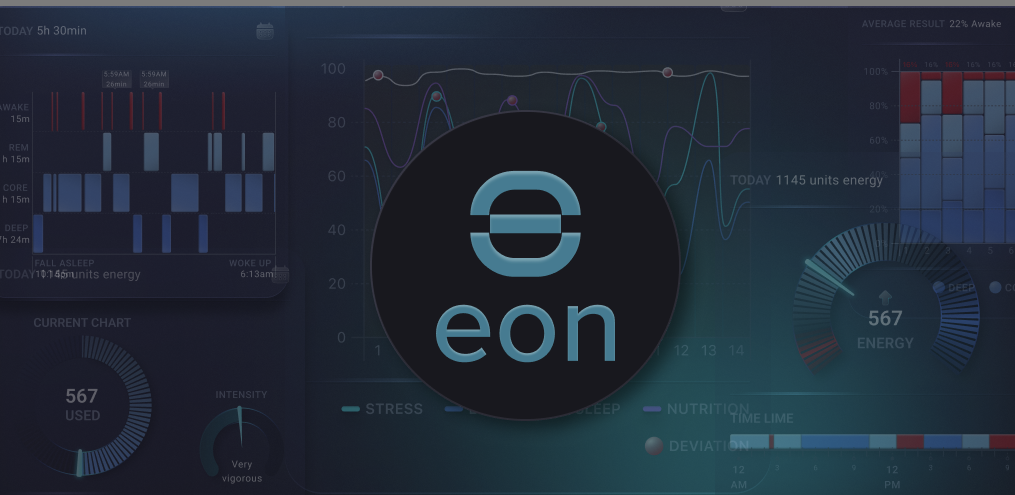
Case Study · HealthTech · THE US
At a Glance
- End-to-end — Full platform design and development: AI engine, mobile apps, scoring framework, admin panel
- 4 health pillars — Sleep, Energy, Stress, Activity — scored, correlated, and explained in real time
- 8+ wearables — Apple Watch, Oura, Garmin, Samsung, Fitbit, Whoop and more via FHIR-compliant APIs
- 136 papers — Peer-reviewed research grounding every scoring algorithm and AI-generated insight
- iOS + Android — Native apps published on App Store and Google Play
The Product
Most health apps tell you what happened. EON Lab was built to explain why
OneVital Corp is a US health technology company building at the intersection of AI, wearable data, and preventive health. EON Lab is its flagship platform — a longevity and health optimization product designed for health-conscious individuals, biohackers, athletes, and preventive care users.
The platform tracks four core lifestyle pillars — sleep, energy, stress, and activity — and scores each on a normalized 0–100 scale using custom machine learning models grounded in 136 peer-reviewed research papers.
The scoring is not the product. The product is the interpretation: why a score changed, how behaviors in one pillar are affecting another, and what the user can do about it.
EON Lab is available on the App Store and Google Play.
The Challenge
Why the same body produces different data depending on the device
The technical challenge wasn’t connecting devices. It was making sure two devices measuring the same thing didn’t produce two different health stories. Different wearables measuring HRV use different algorithms. Different devices tracking sleep stages use different sensor interpretations. Ingesting data from 8+ device types without normalizing those differences at the ingestion layer means the scoring system gives different answers to the same physiological state depending on which device the user wears.
Beyond device normalization, every AI-generated insight had to be grounded in peer-reviewed evidence, scoring models required bias mitigation, data handling required HIPAA-aware architecture, and the system had to surface how sleep affects stress, how stress affects energy — in language a non-clinical user could act on.
Inside the Room
Scoring Against Yourself, Not Against the Population
During discovery, a larger product question emerged. Most health platforms were built around benchmarking users against population averages. OneVital believed that approach produced data, but not understanding. A sleep score of 68 means something different for a user whose consistent baseline is 85 than for someone whose baseline is 65. A standard benchmark would treat both the same way. The product vision shifted toward helping users understand change relative to their own history — even if that meant the system needed time to establish a reliable baseline before scores became fully meaningful.
That was a deliberate product tradeoff: sacrifice immediate scoring output for long-term clinical relevance. It defined the entire architecture that followed — z-score normalization relative to each user’s own history, trend analysis that flags meaningful change for that specific person, and a RAG retrieval layer that contextualized evidence from the research base to the user’s actual data patterns rather than applying generic recommendations.
“Population benchmarks produce scores that are statistically defensible and individually meaningless. We built the scoring engine around each user’s own history, not external reference ranges.”
— Bohdan Bilas, CTO, HebronSoft
What We Built
How we connected device normalization, clinical evidence, and compliance into one architecture
End-to-End Platform Architecture
HebronSoft led the full technical scope of EON Lab: AI and ML architecture, scoring engine, behavioral impact analysis, personalized assistant, wearables integration, native mobile apps, and web admin panel.
The Scoring Engine
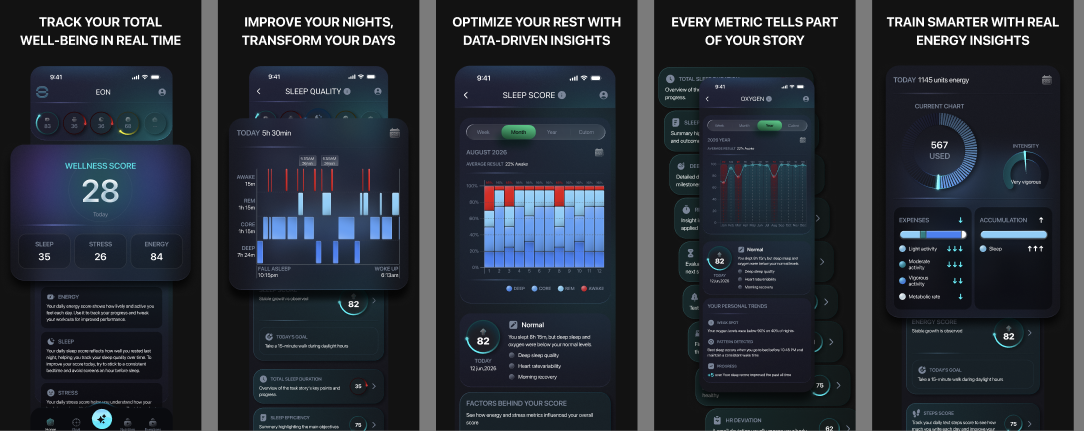
Custom ML models transform continuous wearable data into normalized scores across four pillars. The scoring range is 34–96, reflecting physiological boundaries within which meaningful variation occurs. The framework uses a weighted, multivariate approach with dynamic adjustments based on each user’s longitudinal data. Scores adapt over time as the system builds an individual baseline.
Behavioral Impact Analysis
The platform identifies statistically meaningful correlations across pillars within each user’s own data — how sleep affects stress, how activity affects recovery — and surfaces them in language the user can act on.
The AI Health Assistant
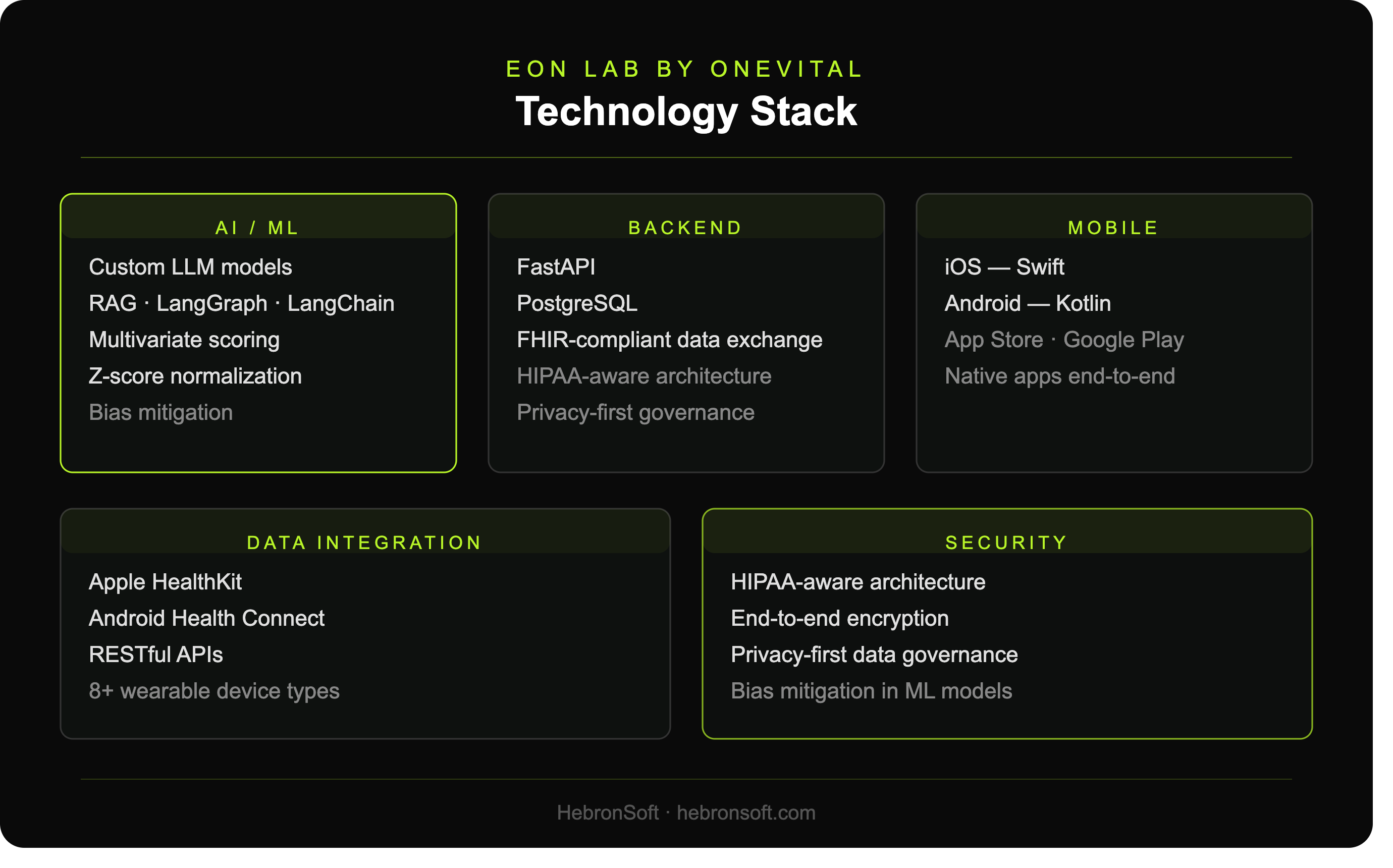
Built on custom fine-tuned LLM models with RAG architecture using LangGraph and LangChain. Rather than reporting that a nutrition score is low, the assistant explains whether the decline correlates with inconsistent meal timing, insufficient recovery, or elevated stress patterns. Every response is grounded in the user’s actual data and the peer-reviewed evidence base.
AI Goal Feature
An AI-guided goal-setting flow where the assistant evaluates current metrics, generates a structured plan with tasks and expected impact, and adjusts recommendations as the user progresses.
Wearables Integration
- FHIR-compliant APIs via FastAPI and PostgreSQL for standardized health data exchange
- Apple HealthKit and Android Health Connect as primary ingestion layers
- 8+ device types: Apple Watch, Oura, Garmin, Samsung, Fitbit, Whoop and more
- Real-time sync with results calculated within 2–5 minutes of app open
- Device-aware normalization at ingestion layer before data reaches scoring models
Native Mobile Applications
- iOS (Swift) and Android (Kotlin) apps designed and developed end-to-end
- Full product lifecycle: UX/UI design, frontend architecture, backend integration
- Dynamic dashboards with score breakdowns, trend indicators, daily/weekly/long-term views
- Web admin panel for user management, platform monitoring, content control, and compliance
Scientific Foundation
136 Studies Behind Every Score and Every Insight
Every scoring model and AI-generated recommendation is grounded in 136 peer-reviewed studies spanning sleep physiology, stress biology, exercise science, and longevity research. The same evidence base powers the RAG retrieval layer of the AI assistant — so responses reference clinical literature, presented in language accessible to non-clinical users.
Business Impact
From Fragmented Device Data to a Single Health Narrative
EON Lab transformed fragmented wearable data into a unified health context that explains relationships between sleep, stress, energy, and activity at the individual level. Users no longer need to interpret data across multiple apps and devices independently — the platform consolidates and contextualizes those signals into a single health narrative that adapts to each person over time.
The FHIR-compliant architecture and evidence-based AI make the platform extensible into clinical and research environments as the product scales.
What We Learned
Two Problems That Took More Work Than Expected
Explaining a score is harder than calculating it
The scoring engine was the engineering challenge. The AI explanation layer was the product challenge. A score of 61 on sleep is straightforward to compute. Explaining that the decline correlates with three days of elevated evening stress, which compressed deep sleep, which reduced overnight HRV recovery — in language that is accurate, not alarming, and actionable — required calibrating LLM fine-tuning, RAG knowledge retrieval, and response formatting together. That calibration took more iteration than the model training.
Device heterogeneity is a data quality problem, not an integration problem
Connecting to Apple HealthKit or Android Health Connect is technically straightforward. The harder problem is that different devices measure the same metric differently: two devices tracking HRV use different algorithms, two devices tracking sleep stages use different sensor interpretations. Ingesting data from 8+ device types without normalizing those differences produces a system that gives different answers to the same physiological state depending on which device the user wears. Device-aware normalization at the ingestion layer — before data reaches the scoring models — was a prerequisite for the entire AI layer to function correctly.
You might be interested in
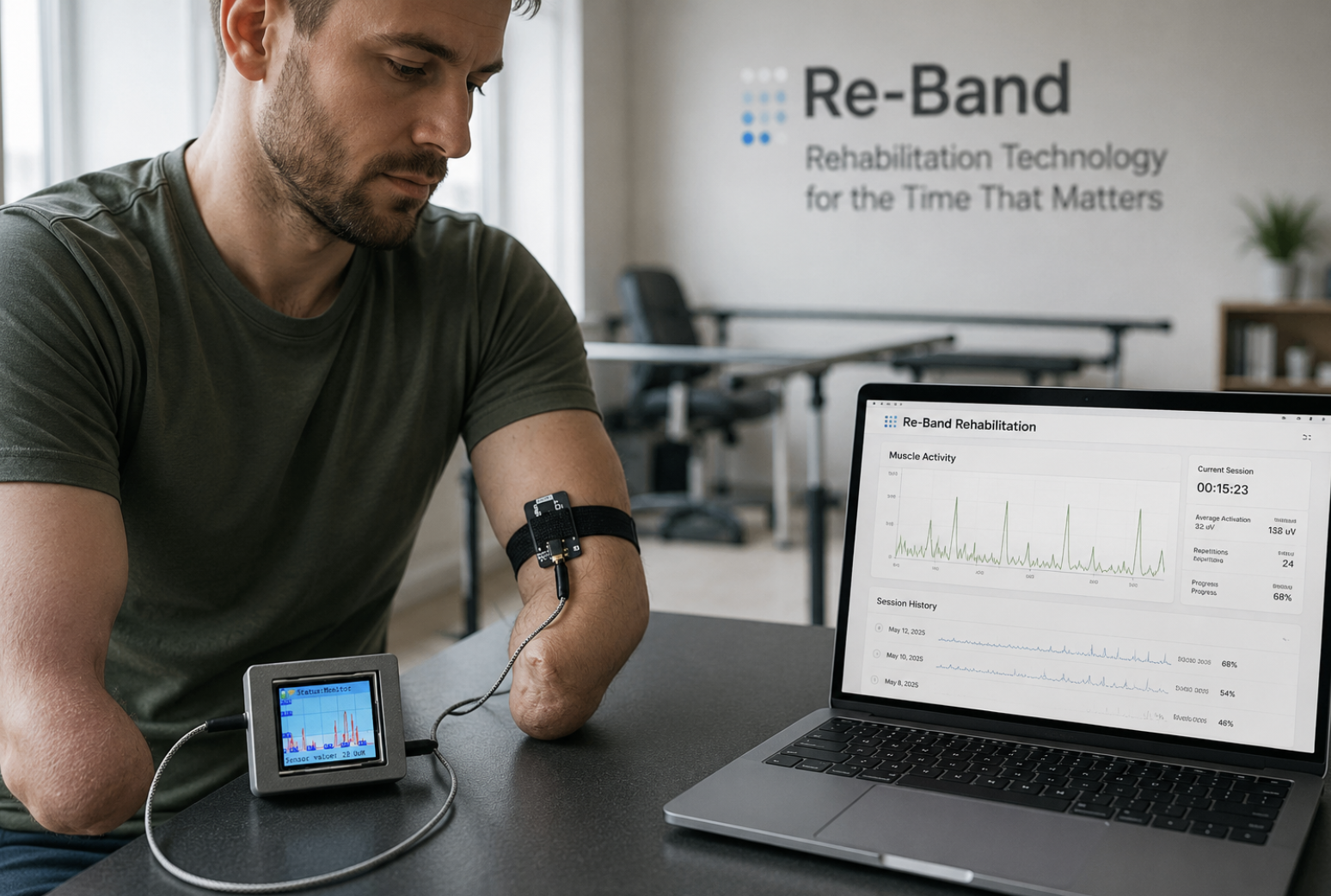
Re-Band: Building the Missing Link in Prosthetic Rehabilitation
A wearable rehabilitation device that helps amputees maintain residual muscle activity while waiting for a prosthesis. Developed inside HebronSoft’s Innovation Lab, Re-Band combines EMG sensing, real-time feedback, remote monitoring, and direct input from veterans, students, engineers, and rehabilitation specialists.
Halo: When Help Can’t Wait, the Drone Arrives First — Inside the Platform That Makes It Possible
A drone-assisted safety platform that turns a single emergency request into real-time drone dispatch, operator routing, live tracking, and secure multi-tenant coordination for campuses and controlled environments.
From Automation to AI: Our Partnership with InflexionPoint
Since 2022, our teams have worked together across industrial automation, life sciences, pharmaceuticals, and advanced manufacturing, combining deep domain expertise with software engineering to help manufacturers modernize operations and build the next generation of connected, data-driven facilities.

 AI Assistant