


From Unfinished MVP to AI-Powered Dentist Finder: The CuspKnows Story
How do you rescue an unfinished HealthTech MVP — and turn it into an AI-powered dentist search platform that scales beyond its original industry?
CuspKnows, an Oklahoma-based HealthTech startup, wanted to make finding the right dentist more personal.
But its first software development engagement left the MVP unfinished.
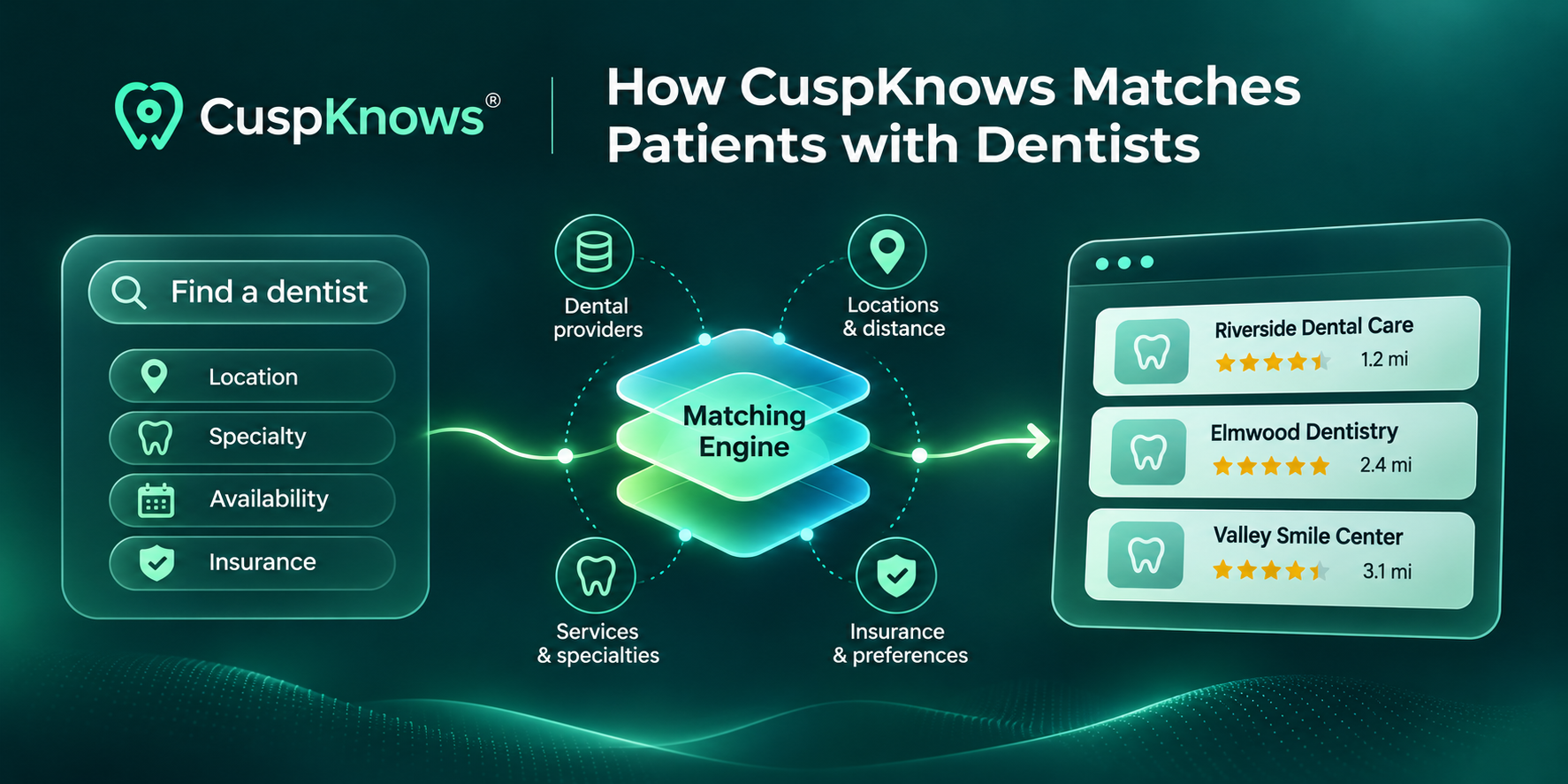
The challenge was not simply to complete the remaining features. The platform needed personalized search functionality capable of connecting patient preferences with dentist profiles and information from external sources.
HebronSoft joined the project, reviewed what had been attempted, built the core platform from scratch, and integrated it — moving CUSP's product vision forward.
Across three documented development phases, the work expanded from personalized dentist search to automotive services, mobile development, and AI-assisted conversational search — proving that the matching core built for dentistry could power any service vertical with minimal reconfiguration.

At a Glance
- Client — CUSP / CuspKnows (cuspknows.com)
- Industry — HealthTech · Dentistry · Consumer Search
- Geography — Oklahoma, USA → US-wide expansion
- Development phases — Nov 2022 – Nov 2023 · Feb – May 2024 · Jun – Jul 2024
- Engagement type — Product Engineering · Tech Advisory · Innovation Lab
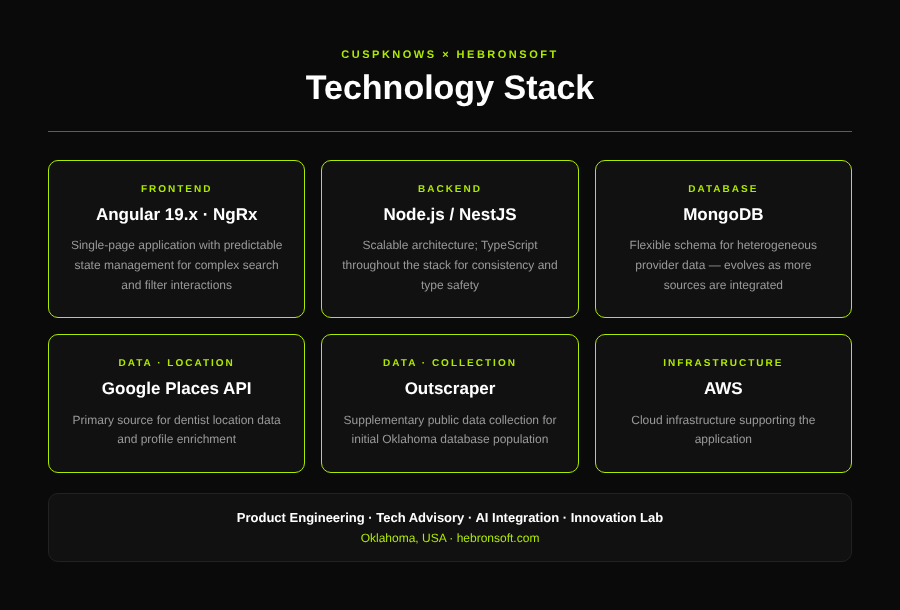
- Tech stack — Angular 19 · Node.js / NestJS · TypeScript · MongoDB · NgRx · Google Places API · Outscraper · AWS
The client
A D.D.S. Who Built What His Patients Needed
Key Facts
- Founder: Russell Brorsen, D.D.S. — Doctor of Dental Surgery, founder of Bluestem Dental, Oklahoma, USA
- Product: CuspKnows — personalized dental search with integrated lending solutions
- Geography: Oklahoma (Phase 1), with architecture built for US-wide expansion
- Stage: Early-stage startup; clinician-turned-founder with deep domain expertise
Russell Brorsen is a Doctor of Dental Surgery (D.D.S.) and the founder of Bluestem Dental in Oklahoma — a practicing clinician who decided that the tools his patients needed to find quality dental care simply didn't exist, so he built them.
CuspKnows is the result of that decision: a software product designed to help patients find the right dental professional based on their individual preferences — built not by a generic tech team chasing a market, but by a practitioner who lives inside the problem every day.
This is what makes the product different. When patients search for a dentist using standard tools — Google Maps, Yelp, insurance directories — they get proximity-based lists with no clinical context. CuspKnows is built on a clinician's understanding of what actually matters in a match: specialization, treatment approach, communication style, and financial accessibility.
The platform pairs personalized search with integrated lending solutions, lowering the financial barrier to dental care for a broad US patient base. Russell represents a growing and important segment in HealthTech: domain experts with the clinical depth to build what their industry actually needs — and the vision to do it.
The Challenge
The MVP Was Unfinished. The Founder Wasn't Giving Up
More than 30% of early-stage startups are forced to partially or fully rewrite their codebase due to poor initial development — losing up to 50% of their reinvested budget and 3 to 6 months of time in the process (Failory). 19% of startups fail directly because of technical team issues or a vendor's inability to deliver the promised product functionality (CB Insights). And 56% of founders exceed their MVP development budget by 2–3× — typically because there was no technical assessment phase before development started (GoodFirms).
CUSP arrived at HebronSoft in exactly this position: an existing codebase from a previous vendor, partially complete, with no matching algorithm and no structured data layer to build one on. The product vision was clear. The technical foundation was not.
This is the pattern HebronSoft's Innovation Lab was built to handle: a founder with validated domain expertise, a first implementation that couldn't deliver the core product promise, and a need for a partner who will assess what exists honestly — and build from there without losing momentum.
The scope challenge was significant: what looked like "finish the MVP" was, on closer inspection, "design and build a matching engine from scratch, on top of unstructured public data." Being direct with the client about that — early — was the first engineering decision on this project.
Inside the Room
The Core Algorithm Simply Didn't Exist Yet
HebronSoft started with an engineering review of what the previous vendor had attempted. Rather than extending the existing code, the team built a new platform from the ground up and integrated it — giving CUSP a clean, maintainable foundation. The goal: understand what the matching engine actually needed to run on before writing a single line.
- The core algorithm — matching patients to dentists based on stated preferences — did not exist. It needed to be designed and built from the ground up.
- Data from Google Maps and review platforms was available but unstructured: no normalized profiles, no consistent specialization categories, no clean schema for ranking.
- A data pipeline for cleaning and normalizing public review data was a prerequisite for the matching engine — a separate engineering problem that hadn't been scoped.
- The existing implementation had components worth preserving, but required a new architectural layer underneath to support the matching, filtering, and ranking logic the product needed.
What looks like "finishing an MVP" often turns out to be building the core system for the first time. The honest conversation at the start is what makes the rest of the project possible.
What We Built
Three Phases. One Matching Core. Built to Scale.
Phase 1 · Dentist Finder (November 2022 – November 2023)
- Authentication system: sign-up, sign-in, password recovery
- Oklahoma dentist database: structured profiles built from Google Places API and Outscraper data
- Data normalization pipeline: cleaning and standardizing raw review and profile data for the matching engine
- Matching algorithm: "dentist portrait" construction from review analysis, relevance scoring against patient preferences
- Multi-parameter filtering UI with direct result actions: call, website, Google Maps navigation
- Patient-facing search experience: from stated needs to ranked, actionable results
Phase 2 · Auto-mechanics Search (February – May 2024)
- Extended CuspKnows into a second vertical: auto mechanics in Oklahoma
- The same universal matching core — reconfigured for automotive service criteria with minimal effort
- Adapted data model, filter set, and provider profiles for the new context
What started as a dentist finder became something bigger
After Phase 2, the team realized: the matching core wasn't specific to dentistry. It was reconfigurable — to any service category, any city, any vertical.
"Cars break down more often than teeth. The idea made sense — and the core was already built to handle it." — Lubomyr Slava, Lead AI Engineer, HebronSoft | CuspKnows Project Team
Phase 3 · Mobile App + AI Integration (June – July 2024)
- Mobile application built on the web platform foundation
- AI conversational search interface: users describe their needs in natural language → system automatically configures filters → returns personalized, ranked results
- Moved the product from "advanced filter UI" to intuitive discovery experience
Business Impact
The Dentist Finder That Learned to Find Auto Mechanics
The engagement helped CUSP move forward with its original vision of personalized service discovery.
The development work covered five key capabilities:
- MVP continuation: assessing and extending an application left partially complete by a previous vendor
- Personalized search: developing dentist search functionality based on user preferences, provider profiles, and reviews
- Actionable results: connecting search results with provider websites, phone calls, and Google Maps
- New service category: extending the search concept to automotive services in Oklahoma
- AI-assisted discovery: conversational search functionality that translates natural-language requests into search parameters

What We Learned
What Working with Early-Stage Products Taught Us About MVPs and Proofs of Concept
A technical handover is a discovery project before it is an engineering project. The time spent understanding what exists — before writing new code — is never wasted. It determines what to change, in what order, and what not to touch.
- Building personalized search on unstructured data is a data engineering problem as much as an application problem. The normalization layer is not a detail — it is the foundation.
- Scope transparency at the start of a project is an engineering decision, not just a commercial one. Both sides benefit from an honest early assessment.
- A matching model is only as good as the data it runs on. The quality of the dentist portrait directly determines the quality of the recommendation.
- A universal matching core, built right, can enter a new service vertical with minimal reconfiguration — dentistry to auto-mechanics proved this. The same engine, different domain.
HebronSoft has navigated this pattern more than once. The Motion TMS engagement followed a similar path — a previous vendor that couldn't deliver, and a product that needed to be rebuilt on a solid foundation.
Read that case →
Frequently Asked Engineering Questions
Can an unfinished MVP be completed by a different development team?
Yes. A new engineering partner can assess an existing codebase, identify missing functionality, and determine the best path forward — without necessarily starting over. The CuspKnows engagement began with understanding work left partially complete by a previous vendor before continuing development. Whether an MVP should be extended or rebuilt depends on the technical condition of the existing application and the product's actual requirements.
How do you build a personalized search and matching platform?
A personalized search platform combines information about available providers with user preferences and search criteria. Depending on the application, this may involve third-party data integrations, review analysis, filtering, and custom matching logic. For CuspKnows, the matching engine was built by analyzing dentist profiles and reviews to construct a "dentist portrait" — then ranking results against each patient's stated preferences. The same approach was later adapted to auto-mechanics, demonstrating its potential beyond dentistry.
How can conversational AI improve a search application?
Conversational AI allows users to describe their needs in natural language instead of manually selecting filters. An AI-assisted interface interprets those requests and configures relevant search parameters automatically — making the discovery experience more intuitive and accessible. CuspKnows integrated this capability in its third development phase, shifting from a filter-based UI to a natural language interface.
Can a personalized search platform support multiple industries?
Yes, when the matching core is built as a reusable engine rather than a single-use product. CuspKnows extended from dental services to auto-mechanics in Phase 2 — the same universal matching core, reconfigured for a new service category with minimal additional effort. The key is designing the data model and matching logic to be domain-agnostic from the start.
Have an Unfinished MVP or a Complex Product Idea?
CuspKnows illustrates a challenge many founders face: the product vision is clear, but the existing implementation needs additional engineering work.
HebronSoft helps product teams assess existing codebases, continue unfinished software projects, develop custom search and matching functionality, and integrate AI capabilities into digital products.
Need a technical partner to move your product forward?
The matching engine built for CuspKnows is designed to work beyond dentistry — if you're building a discovery or marketplace product, the core is already proven.
Explore HebronSoft's Innovation Lab or talk to our engineering team.

Trusted, loyal and smart tech partner — take what was left partially complete from other vendor
We were advised to engage HebronSoft to help us finish the MVP phase of our CuspKnows application. We needed a trusted, loyal and smart tech partner who can take what was left partially complete from other vendor and we knew that was not easy task. HebronSoft invested their time and effort to understand the state of the project and code, after which they started their help. We couldn't be more happy since then — always responsive and proactive, overcoming bumps on the road together if they happen. They are smart, intelligent engineers and tech partner to us.


You might be interested in
EON Lab by OneVital: An App That Explains Your Health, Not Just Tracks It
How HebronSoft designed and engineered the AI, scoring models, wearable integrations, and mobile applications behind EON Lab.
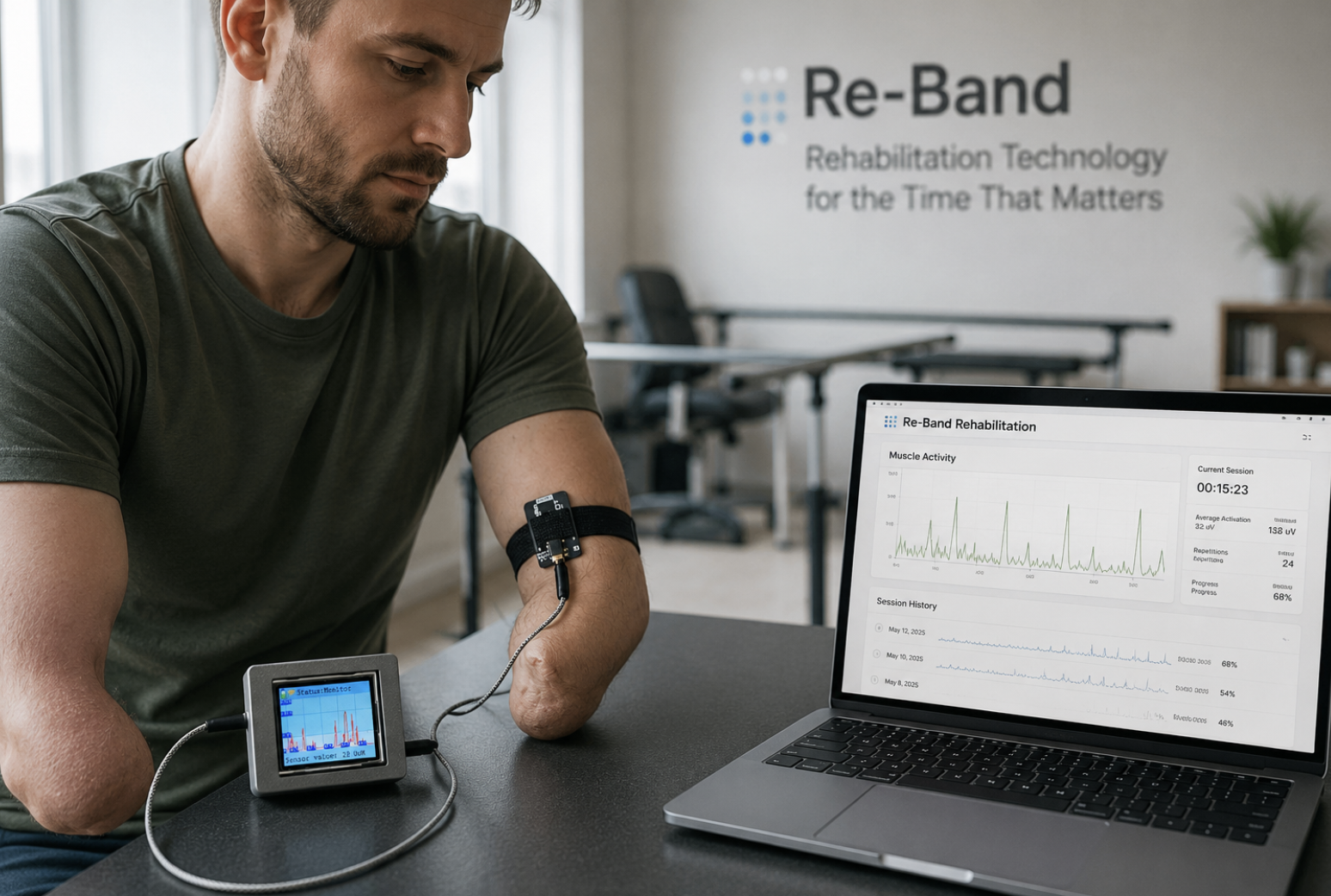
Re-Band: Building the Missing Link in Prosthetic Rehabilitation
A wearable rehabilitation device that helps amputees maintain residual muscle activity while waiting for a prosthesis. Developed inside HebronSoft’s Innovation Lab, Re-Band combines EMG sensing, real-time feedback, remote monitoring, and direct input from veterans, students, engineers, and rehabilitation specialists.
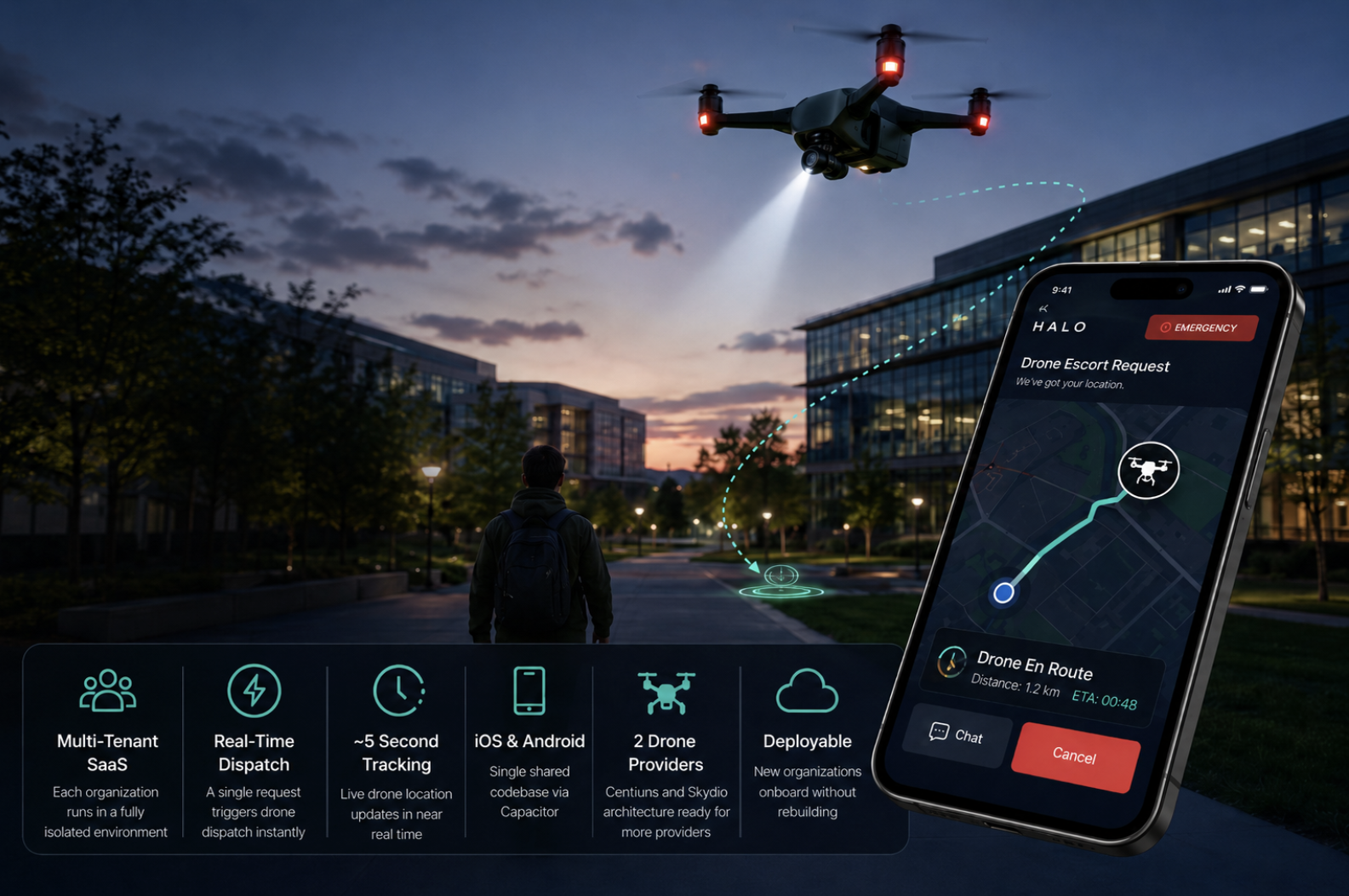
Halo: When Help Can’t Wait, the Drone Arrives First — Inside the Platform That Makes It Possible
A drone-assisted safety platform that turns a single emergency request into real-time drone dispatch, operator routing, live tracking, and secure multi-tenant coordination for campuses and controlled environments.
 AI Assistant